TEHRAN (Kashmir English): New details have been emerged regarding who will lead the funeral prayer of Shaheed Ali Khamenei, who was martyred in a joint attack by Israel and the United States on February 28.
According to the Iranian media, the funeral prayers of former Supreme Leader Ayatollah Ali Khamenei and his family will be performed in various cities under the leadership of prominent Shiite religious scholars.
The funeral prayer in Tehran will be led by Ayatollah Jafar Sobhani Tabrizi, while in Qom, Ayatollah Naser Makarem Shiraziand in Mashhad, Ayatollah Hossein Noori Hamedani will lead the funeral prayers.
international news agency, the funeral of Shaheed Ali Khamenei began yesterday, July 3, at the Imam Khomeini Grand Mosque in Tehran, when international delegations visited the bodies, recited Fateha and recorded words of condolence.
Today, July 4, the bodies of Shaheed Ali Khamenei and his family were placed in a glass coffin for public viewing, where millions of mourners from all over the country will also recite Fateha throughout the day.
Tomorrow, Sunday, July 5, a funeral prayer will be offered at dawn, in which more than 10 million people, including representatives from 100 countries, are expected to participate. After that, the body will be taken from Tehran to Qom in a procession.
The next day, the body will be taken from Qom to the Iraqi cities of Najaf and Karbala, and funeral prayers will be offered there as well. The body will then be brought back to Iran and buried at the Imam Reza shrine in Mashhad on July 9.
There has been no final announcement yet regarding the attendance of Ali Khamenei’s son and current Supreme Leader of Iran, Mojtaba Khamenei, at the funeral prayers.
BBC Persian claimed that Ali Akbar, the secretary of the funeral administration, said that the decision on the participation of Mojtaba Khamenei will be made by the Supreme Leader’s family.
If the family decides to attend the funeral, it will be formally announced by his office.
Iran begins six days of funeral rites for late supreme leader Khamenei
Iran officially began the six-day public funeral ceremonies for late supreme leader Ayatollah Ali Khamenei at the Imam Khomeini Mosalla in Tehran on Saturday morning, state television reported, with processions due to continue in Iraq before his burial.
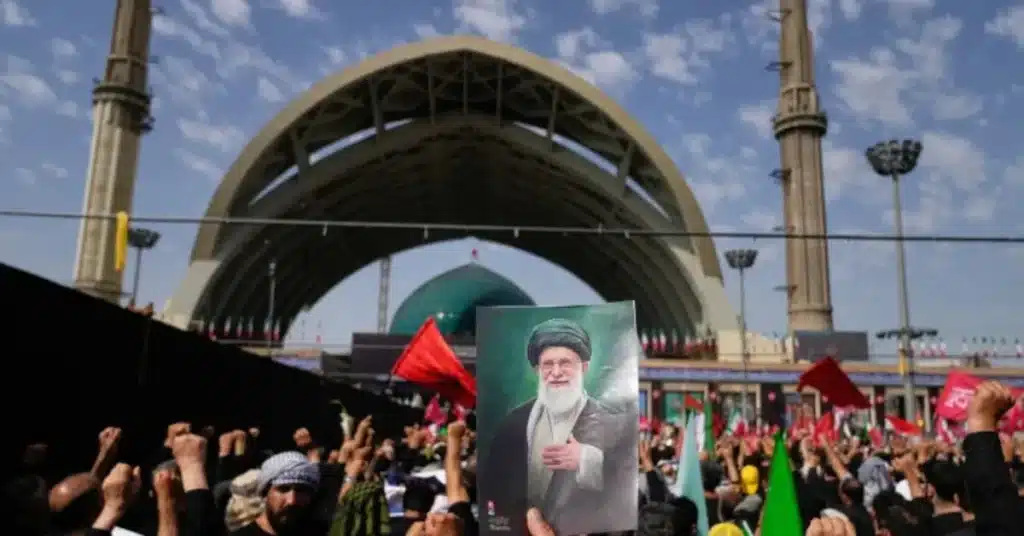
The Grand Mosalla was filled with Quran recitations, elegies, and mourners from across Iran as people paid their final respects. The venue opened before the scheduled start to accommodate those who had waited through Friday night around the complex and nearby streets.
Thousands of mourners carrying red banners, a symbol associated with calls for revenge, gathered in the courtyard of Mosalla ahead of the arrival of Khamenei’s coffin, chanting “death to America” and “revenge, revenge”, AFP reported.
According to the official schedule, public farewell ceremonies will continue in Tehran on July 4 and 5, followed by the funeral procession in the capital on July 6. The coffin will then be transferred to Qom on July 7, before ceremonies in the Iraqi holy cities of Najaf and Karbala on July 8 and a final burial ceremony in Mashhad on July 9.
Earlier, Fars News Agency reported that Iran’s Commander-in-Chief of the Law Enforcement Command, Brigadier General Ahmadreza Radan, said that 65,000 personnel will be deployed across the provinces of Tehran, Qom, and Mashhad to ensure security and maintain order during the ceremonies.
Radan added that another 200,000 personnel have been assigned to secure roads and border areas stretching from Iran’s frontiers to the three host provinces. Authorities have also planned the deployment of 16,000 special patrol units and the establishment of 15,000 security checkpoints.
Announcing the country’s full preparedness to receive foreign guests, Radan said that all air and land entry points have been readied for visitors traveling to attend the ceremonies in Tehran, Qom, or Mashhad, and that all law enforcement, security, and protective measures required for the events have been put into effect.
On Friday, a ceremony was held in Tehran for foreign delegations to pay tribute to the martyred Leader. It brought together one of the largest gatherings of foreign dignitaries in Iran in recent decades, with representatives from across Asia, Africa, Europe, the Americas, and major international organizations attending the event.
Delegations comprising political figures, religious scholars, and cultural figures from India, Russia, Pakistan, Norway, Sri Lanka, the United Kingdom, Cambodia, Greece, Sweden, Myanmar, Thailand, Indonesia, Afghanistan, and several other countries attended the ceremony.