
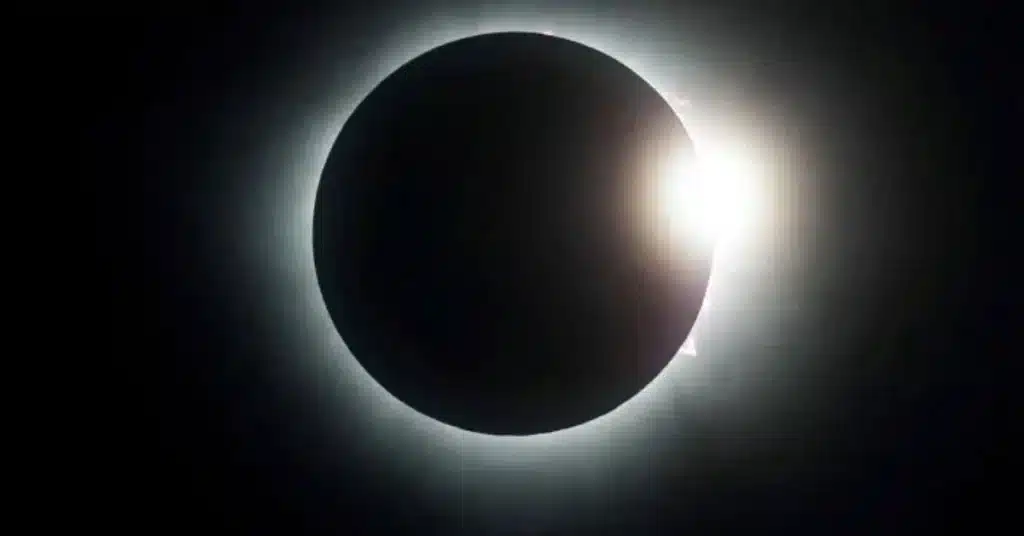
KARACHI (Kashmir English): This year’s last total solar eclipse will occur on the night of August 12-13, but it will not be visible in Pakistan, the Meteorological Department has said.
The Pakistan Meteorological Department (PMD) said the eclipse would begin at 8:34 pm Pakistan Standard Time (PST) on August 12, reach its peak at 10:46 am and end at 12:58 am on August 13.
The PMD added that the eclipse would be visible from parts of Greenland, Iceland, Spain and Russia, while a partial eclipse would be observed across parts of Europe, Africa and the Americas.
What is a solar eclipse?
A solar eclipse occurs when the Moon passes directly between the Sun and Earth, temporarily blocking sunlight and casting a shadow on parts of the planet.
The August 12 event is particularly significant as it will be the first total solar eclipse visible from mainland Europe since 2006.
Along the path of totality, the Moon will completely cover the Sun, briefly turning day into twilight and revealing the Sun’s outer atmosphere, known as the corona.
Astronomers note that while one or two solar eclipses occur globally each year, total eclipses are relatively rare for any specific location because the Moon’s shadow covers only a narrow path across the Earth’s surface.
Future solar eclipses
A total solar eclipse will cross southern Spain, northern Africa and the Arabian Peninsula on August 2, 2027. Its totality will last six minutes and 23 seconds. Experts believe that a longer eclipse will not occur until 2114.
On January 26, 2028, annular eclipse — or “ring of fire” — will be observed again from parts of Spain when it crosses southern areas.
Lunar eclipse later this month
The PMD also announced that a partial lunar eclipse would occur on August 28, however, it would likewise not be visible in Pakistan.
Experts advise against looking directly at the Sun during an eclipse without certified eye protection, as doing so can cause serious and permanent eye damage.