
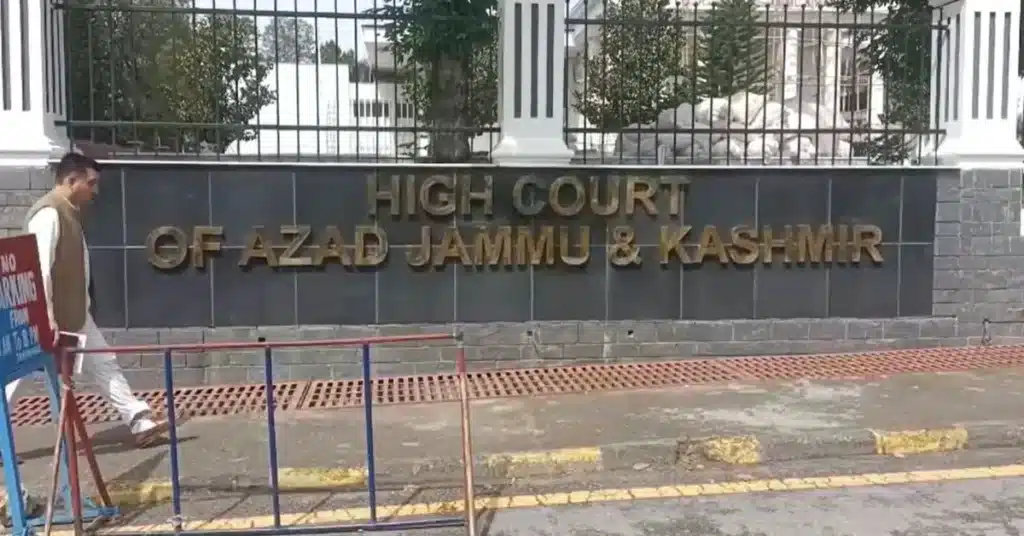
MUZAFFARABAD (Kashmir English): In a major decision, the Azad Jammu and Kashmir High Court on Tuesday suspended and issued a stay order on the recently implemented legislation aimed at regularising the services of ad hoc, temporary, and contractual employees in the state.
A single-member bench, comprising High Court Judge Justice Sardar Ejaz Khan, heard the preliminary hearing of the case, titled “Khizar Saleem vs. Azad Government and others”, while accepting the application for regular hearing and issuing a stay order on the Act.
On June 16, the AJK Legislative Assembly unanimously approved two bills to regularise over 4000 temporary, ad hoc, and contract employees, mostly of grades 1 to 15, posted in various public-sector departments across AJK.
Following the approval from the House, a petition was filed in the High Court against the ‘AJK Regularisation of Services of the Ad-hoc or Temporary Employees Act, 2026,’ on July 3.
Following today’s interim order, the proceedings under the said Act will remain suspended till the next court decision. Further hearing of the case will be held on a later date.
Regularization of ad hoc employees
Earlier on July 4, the AJK government announced to start implementing legislation to regularise the services of ad hoc, temporary, and contractual employees.
The Services and General Administration Department of the AJK government issued a circular, directing all administrative secretaries, heads of departments, and relevant authorities to initiate the process of regularizing eligible ad hoc employees in accordance with the newly approved law, sources said.
The circular instructs all departments to complete the required legal and administrative formalities without delay and ensure implementation in line with the prescribed rules and regulations.
Last month, the law minister Mian Abdul Waheed tabled the AJK Regularisation of Services of Ad hoc or Temporary Employees (Basic Pay Scale-1) Ordinance, 2026, and the AJK Regularisation of Services of Ad hoc or Temporary Act, 2026.
Speaking after the passage of the laws, the law minister said the issue had remained unresolved for years despite many employees having served for more than a decade under repeated extensions of their appointments.