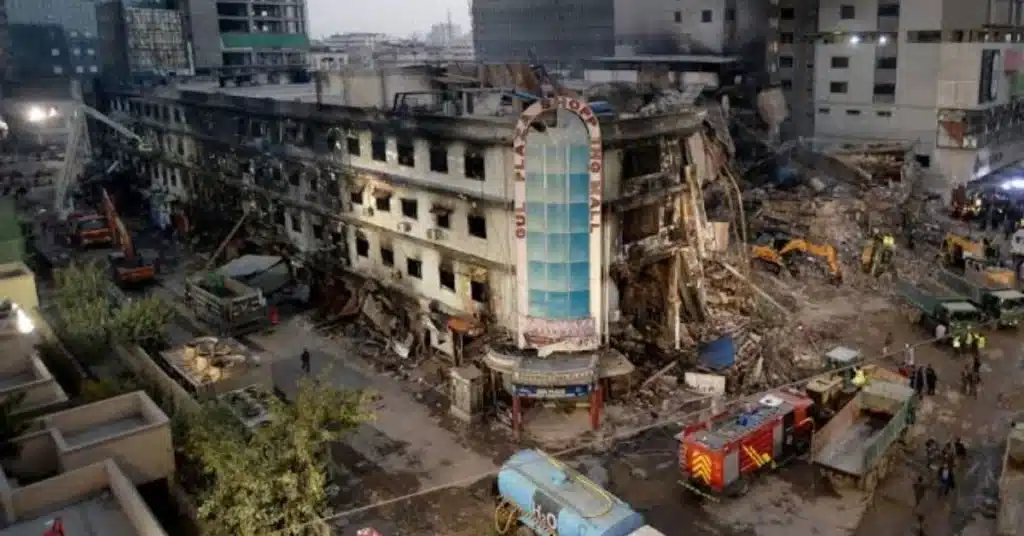
KARACHI (Kashmir English): The Sindh Home Department has released the report of the Judicial Commission constituted to investigate the Gul Plaza fire tragedy in Karachi, identifying multiple institutional and administrative failures that contributed to the loss of lives.
The fire killed at least 73 people at the multi-storey commercial building on M.A. Jinnah Road in Karachi on January 17.
According to the report, Gul Plaza remained in commercial use despite serious safety violations and known defects. The plaza administration failed to rectify the shortcomings identified in Civil Defense reports issued in 2024 and 2025, which had pointed out the absence of adequate fire safety equipment.
The commission also found flammable materials inside the building and shortcomings in emergency exit routes.
It noted that there was an unreasonable delay in informing the fire brigade after the fire broke out, while the subsequent power outage plunged the building into darkness and further reduced the chances of escape from the upper floors.
Despite the presence of a public address system in the building, it was not used during the emergency, the report said.
The commission further revealed that the approved plan of Gul Plaza provided for 1,102 shops, while 1,153 shops were actually operating in the building. A large quantity of flammable merchandise was also stored inside the shops.
The report said shopkeepers also prevented some customers from exiting the building, further worsening the situation.
The commission found that the fire brigade was delayed in reaching the site, contrary to its prescribed response standards. Effective firefighting operations began around 35 to 40 minutes after the fire broke out.
According to the report, water shortages and the need to refill firefighting vehicles also affected rescue and firefighting efforts.
The report noted that despite claims of adequate water availability at fire stations, the lack of an effective water supply during the initial stage of the incident represented a major administrative failure.
It added that the rescue officials arrived after the fire broke out, but even then there was an effective chance for rescue.
“Rescue was possible from 11:15 to 11:20 and some victims were also visible in the building, and access to the building from the ramp was also possible until 11:30, but Rescue 1122 did not convert the available time into a large-scale operation,” according to the report.
The report concluded that people lost their lives not only because of the fire itself but also due to delays, darkness, blocked roads, missed rescue opportunities, inactive safety systems, and ineffective inspections and audits.
The report states that under the law, electrical installations and equipment were to be inspected regularly. However, according to the statement of the electric inspector, no regular electrical inspection of Gul Plaza was carried out.
“The responsibility is not limited to any one institution or one government. Legal powers, audit system, building control, firefighting and emergency response institutions were in place at various times, but this system as a whole could not function effectively,” it added.