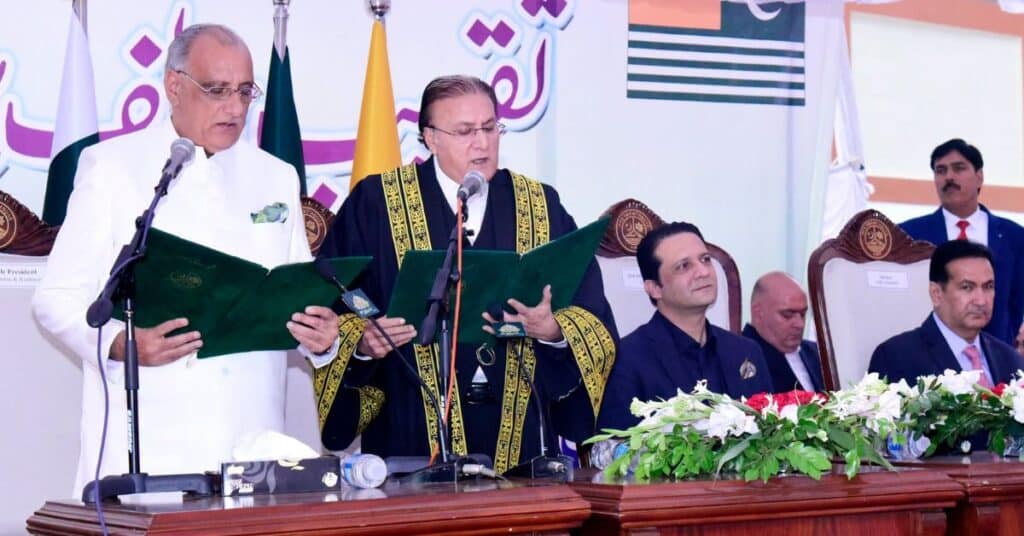

ISLAMABAD (Kashmir English): The Supreme Judicial Council rejected 70 out of 74 complaints against judges, accepted 3 for further action, while postponing action on one.
A meeting of the Supreme Judicial Council was held under the chairmanship of Chief Justice Yahya Afridi, in which the Supreme Judicial Council approved amendments to the code of conduct of judges by majority vote.
Two separate meetings of the Judicial Council were held, and the first meeting was attended by Chief Justice Yahya Afridi, Justice Mansoor Ali Shah and Justice Muneeb Akhtar, Lahore High Court Chief Justice Alia Neelam, and Islamabad High Court Chief Justice Sarfaraz Dogar.
According to the announcement, the second meeting of the Supreme Judicial Council was attended by the Chief Justice of the Peshawar High Court in place of Islamabad High Court Chief Justice Sarfaraz Dogar.
According to the announcement, 67 complaints were reviewed under Article 209 of the Constitution, 65 complaints were unanimously rejected, one was postponed, and one was approved for further action by a majority decision.
The council was reconstituted due to the non-participation of the Chief Justice of the Islamabad High Court.
In the second meeting of the Supreme Judicial Council, 7 complaints were reviewed, and the Supreme Judicial Council decided to take further action on 2 complaints by majority vote, while the council filed 5 complaints in the office.
The announcement stated that 155 complaints have been considered since October 2024, and 87 complaints are pending for initial consideration after decisions on 74 complaints.
Key points: Judge code of conduct
The Council added Articles XII, XIII, XIV, and XV to the Code of Conduct with the specific purpose of strengthening judicial integrity and impartiality.
The Council prohibited Judges of the higher Courts from attending/presiding over any social, cultural, political, and diplomatic events.
As per Article XIII, “Soliciting invitation by the Judges to attend conferences/meetings from foreign/international agencies would be taken as misconduct and if any such invitation is extended to a Judge in his personal name, he would intimate the inviter to channel such invitation through the concerned Chief Justice”.
SJC also prohibited judges from accepting an invitation to dinner/reception to be hosted in their honor from an individual member of the Bar.
“A Judge is not supposed to be swayed by any consideration other than merit.
He must have the intellectual ability and moral character to be independent and steadfast in the face of influence, internal influence or external influence”, Article XV stated. “If no legal powers are present, he is to apply an institutional response promptly.”.