ISLAMABAD (Kashmir English): As the holy month of Ramadan and the joyful celebrations of Eid ul Fitr fade into memory, the hearts of Muslims across Pakistan are already turning toward the most spiritually significant occasion of the Islamic calendar Eid ul Adha 2026. Known across Pakistan as Bakra Eid or Bari Eid, this is the Festival of Sacrifice, a day of profound religious meaning, communal unity, and deep personal devotion.
Here is everything you need to know about Eid ul Adha 2026 in Pakistan from the expected date and moon sighting process to public holidays, Qurbani rules, Hajj timing, and every related question answered in full.
What Is the Expected Date of Eid ul Adha 2026 in Pakistan?
Based on astronomical calculations for the Islamic lunar calendar, Eid ul Adha 2026 in Pakistan is expected to fall on Wednesday, May 27, 2026, corresponding to the 10th of Dhul Hijjah 1447 AH.
This prediction is based on the anticipated birth of the Dhul Hijjah crescent moon around May 17 or 18, 2026. If the moon is sighted on the evening of May 17, Dhul Hijjah would begin on May 18 and Eid ul Adha would fall on May 27. A one-day shift remains possible depending on actual moon visibility conditions across Pakistan.
As always, the final official date will be announced by Pakistan’s Central Ruet-e-Hilal Committee following the physical sighting of the Zil Hajj moon. Until that announcement is made, May 27 remains the most widely cited and scientifically supported expected date.
What Is Eid ul Adha and Why Is It Celebrated?
Eid ul Adha literally meaning the Festival of Sacrifice is the holier of Islam’s two major annual festivals and carries greater spiritual weight than even Eid ul Fitr. It commemorates one of the most powerful acts of faith in all of religious history: the moment when Prophet Ibrahim (AS) demonstrated his absolute submission to Allah by preparing to sacrifice his beloved son, Prophet Ismail (AS), in obedience to a divine command.
Before the sacrifice could be carried out, Allah in His infinite mercy replaced Ismail (AS) with a ram signaling to Ibrahim (AS) and to all of humanity that sincere intention, complete trust in Allah, and willingness to surrender one’s most precious possession in His name are what truly matter. The physical act was accepted; the spirit behind it was what was being tested.
This event is referenced in the Holy Quran in Surah As-Saffat (37:102), and its legacy lives on every year through the ritual of Qurbani — the sacrifice of a livestock animal performed by Muslims who can afford it, as a personal act of worship and remembrance of Prophet Ibrahim’s (AS) devotion.
Eid ul Adha also coincides with the climax of the Hajj pilgrimage in Makkah — one of the Five Pillars of Islam — making this day a moment when the entire global Muslim community is spiritually united, whether standing on the plains of Arafat or celebrating at home in Lahore, Karachi, or Muzaffarabad.
When Is the Zil Hajj Moon Sighting 2026 in Pakistan?
The Zil Hajj (Dhul Hijjah) moon sighting in Pakistan is expected to take place on the evening of Saturday, May 16 or Sunday, May 17, 2026. On that evening, the Central Ruet-e-Hilal Committee will convene its formal session after Maghrib prayers, collecting eyewitness moon sighting reports from across the country including Karachi, Lahore, Islamabad, Peshawar, Quetta, and other cities.
SUPARCO and the Pakistan Meteorological Department will provide scientific assessments of moon visibility to assist the committee. However, as with all Islamic months in Pakistan, the final decision rests on verified physical testimony rather than calculation alone.
If the Zil Hajj moon is confirmed on May 16, the first of Dhul Hijjah would be May 17 and Eid ul Adha on May 26. If sighted on May 17, Dhul Hijjah begins May 18 and Eid falls on May 27. The May 27 date is considered the more probable outcome based on current astronomical modeling.
What Are the Expected Eid ul Adha 2026 Public Holidays in Pakistan?
The Government of Pakistan typically announces three official public holidays for Eid ul Adha. Based on the expected date of May 27, the anticipated holiday schedule is as follows:
| Day | Date | Holiday |
|---|---|---|
| Wednesday | May 27, 2026 | Eid ul Adha — Day 1 (10 Zil Hajj) |
| Thursday | May 28, 2026 | Eid ul Adha — Day 2 (11 Zil Hajj) |
| Friday | May 29, 2026 | Eid ul Adha — Day 3 (12 Zil Hajj) |
If the holiday period runs from Wednesday through Friday and naturally connects with the weekend, workers and students across Pakistan could enjoy a five-day break from Wednesday May 27 through Sunday May 31 — making this one of the most generous Eid breaks in recent years. Schools, government offices, banks, and most businesses will remain closed for the duration of the official holiday period.
Provincial governments may adjust dates by one day depending on their own moon sighting decisions, particularly in Khyber Pakhtunkhwa which historically has sometimes announced moon sightings earlier than the central committee.
When Is the Day of Arafah 2026?
The Day of Arafah falls on the 9th of Dhul Hijjah one day before Eid ul Adha. Based on the expected date of May 27 for Eid ul Adha, the Day of Arafah in 2026 is expected on Tuesday, May 26, 2026.
The Day of Arafah holds extraordinary religious significance in Islam. It is the day when Hajj pilgrims gather on the plains of Arafat near Makkah in the most powerful act of the entire pilgrimage — standing before Allah in supplication, repentance, and devotion.
For Muslims who are not performing Hajj, the Prophet Muhammad (PBUH) described fasting on this day as carrying the reward of sins being forgiven for two full years — the year that has passed and the year ahead. It is one of the most highly recommended voluntary fasts in the entire Islamic year. Many Pakistani families observe this fast every year, combining personal worship with a sense of spiritual solidarity with the pilgrims in Makkah.
When Is Hajj 2026?
The Hajj pilgrimage of 2026 is expected to take place between Monday, May 25 and Saturday, May 30, 2026, corresponding to the 8th through 13th of Dhul Hijjah 1447 AH. The key dates within Hajj are:
| Hajj Day | Islamic Date | Expected Gregorian Date |
|---|---|---|
| Yawm al-Tarwiyah | 8 Dhul Hijjah | May 25, 2026 |
| Day of Arafah | 9 Dhul Hijjah | May 26, 2026 |
| Eid ul Adha / Yawm al-Nahr | 10 Dhul Hijjah | May 27, 2026 |
| Days of Tashreeq | 11–13 Dhul Hijjah | May 28–30, 2026 |
Millions of Muslims from Pakistan travel to Makkah every year to perform this sacred pilgrimage. For those unable to make the journey, the spirit of Hajj is kept alive through Qurbani, fasting on the Day of Arafah, and increased worship during the blessed first ten days of Dhul Hijjah.
What Are the Rules of Qurbani in Pakistan?
Qurbani — the ritual animal sacrifice performed on Eid ul Adha is a deeply important act of worship in Pakistan and a major religious, social, and economic event. Here are the key rules every Pakistani family needs to know:
Who Must Perform Qurbani? Qurbani is obligatory (Wajib according to the Hanafi school, which is the dominant legal school in Pakistan) for every adult Muslim who is sane, not a traveler, and possesses wealth equal to or above the Nisab threshold — the minimum amount of wealth beyond which Zakat becomes obligatory. Those below this threshold are not required to sacrifice but may do so voluntarily.
Which Animals Are Valid for Qurbani? Only specific animals are acceptable for Qurbani under Islamic law: goats, sheep, cows, buffaloes, and camels. A single goat or sheep serves as one complete Qurbani for one household. A cow, buffalo, or camel can be shared among up to seven individuals or families, with each share counting as one full Qurbani.
What Are the Age Requirements? Animals must meet minimum age requirements. A goat or sheep must be at least one year old. Sheep may be accepted at six months if they appear the size and health of a one-year-old. Cows and buffaloes must be at least two years old. Camels must be at least five years old.
When Can Qurbani Be Performed? Qurbani can be performed on the 10th, 11th, and 12th of Dhul Hijjah — that is, from Eid day itself through the following two days (the Days of Tashreeq). It cannot be performed before the Eid prayer on Day 1. The recommended practice is to perform Qurbani as early as possible on Eid day.
How Is the Meat Divided? Islamic tradition divides Qurbani meat into three equal portions: one-third for the family, one-third for relatives and friends, and one-third for those in need. This distribution is not merely custom — it is an act of worship that embodies the core Eid ul Adha values of generosity, solidarity, and care for the less fortunate.
What Will Sacrificial Animal Prices Be in Pakistan in 2026?
Pakistan’s livestock markets from Karachi’s Northern Bypass to Lahore’s Shahpur Kanjra begin operating weeks before Eid ul Adha, drawing traders, farmers, and buyers from across the country. Market observers have noted that sacrificial animal prices in 2026 are expected to be higher than last year, driven primarily by increased feed costs, general inflation, and the economic pressures that continue to affect Pakistan’s agricultural sector.
Buyers are advised to begin their search well in advance of Eid to secure animals at reasonable prices, as prices typically spike dramatically in the final three to four days before Eid when demand peaks and supply tightens.
For families unable to afford local Qurbani, a growing number of charitable organizations and digital platforms offer the option of donating the cost of a Qurbani to be performed on their behalf in underprivileged communities both within Pakistan and in other Muslim-majority countries facing hardship.
How Is Eid ul Adha Celebrated in Pakistan?
Eid ul Adha in Pakistan is an experience unlike any other a festival that engages all the senses and touches every corner of the country simultaneously.
The day begins well before sunrise as families wake for Fajr prayers, followed by the Ghusl (ritual bath), putting on new or freshly washed clothes, and the recitation of the Takbeer — the declaration of Allah’s greatness — which fills the air from the first morning of Dhul Hijjah and continues through all five prayers until the Asr of the 13th.
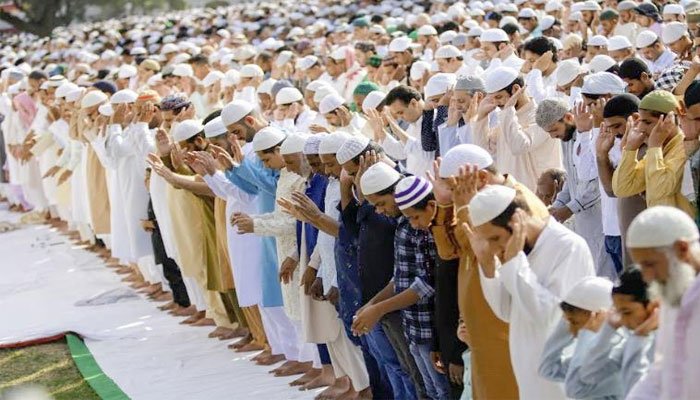
Eid prayers are offered in mosques and open grounds across every city, town, and village. The congregation at Badshahi Mosque in Lahore, Faisal Mosque in Islamabad, and mosques from Gilgit to Gwadar becomes a powerful demonstration of Muslim unity.
After prayers comes the Qurbani, the morning air alive with the sounds of activity as families carry out their sacrifices. Neighborhoods share the work communally, with butchers in high demand and the entire local economy buzzing. By afternoon, the smell of fresh meat cooking drifts through every street seekh kebabs, karahi, nihari, and slow-cooked shorba simmering in enormous pots.
Children receive Eidi, families visit relatives, and the distribution of meat to neighbors, household staff, and the poor turns the entire three-day holiday into an extended act of collective charity and togetherness.
Why Does Pakistan Sometimes Celebrate Eid ul Adha One Day After Saudi Arabia?
This is a question that arises reliably every year, and the answer lies in geography, tradition, and Islamic jurisprudence.
The Islamic lunar month begins and ends with the physical sighting of the crescent moon. Because Pakistan and Saudi Arabia are located in different parts of the world, the crescent can become visible in the Arabian Peninsula before it is visible over the skies of South Asia. Saudi Arabia sometimes confirms the Zil Hajj moon one evening before Pakistan’s Ruet-e-Hilal Committee receives sufficient testimony from within Pakistani territory.
Pakistan has consistently maintained its own independent moon sighting process, and scholars of the Hanafi school — whose rulings govern the majority of Pakistani Muslims — have historically supported the principle that each country or region must sight the moon within its own jurisdiction. This means that even when Saudi Arabia announces a date, Pakistan may celebrate Eid one day later.
This difference is not a source of religious conflict. It is simply the natural outcome of a lunar calendar applied honestly across a geographically diverse world.
What Are the First Ten Days of Dhul Hijjah and Why Are They Special?
Long before Eid ul Adha arrives, the Islamic calendar enters one of its most blessed periods: the first ten days of Dhul Hijjah. The Prophet Muhammad (PBUH) described these as the best days of the entire year — days in which good deeds carry extraordinary reward and worship is especially beloved by Allah.
Based on the expected Dhul Hijjah start of May 18, these blessed ten days in 2026 would run from May 18 through May 27, concluding with Eid ul Adha itself.
Recommended acts during these days include: increased voluntary prayers, fasting (especially on the Day of Arafah for non-pilgrims), recitation of Takbeer, Tahmeed, and Tahleel, giving in charity, seeking forgiveness, and refraining from cutting hair and nails for those who intend to perform Qurbani a Sunnah practice that connects the person making sacrifice to the spirit of the Hajj pilgrims in Makkah.
Dates of Eid-ul-Adha and Dhul-Hijjah
According to Dr. Faheem Hashmi, Dhul-Hijjah is likely to begin on May 17. On scientific grounds, Eid al-Adha is predicted to occur on May 27. Dhul-Hijjah is the last month of the Islamic year, in which important acts of worship such as Hajj and sacrifice are performed.
Experts agree that astronomical calculations are quite accurate; however, in Pakistan, religiously, the sighting of the moon is the decisive factor. Therefore, the final dates of Ramadan and Eid will be announced by the Central Ruet-e-Hilal Committee.
Nevertheless, these predictions by astronomers provide important guidance to the public in planning and mental preparation.
Quick Reference: Eid ul Adha 2026 Key Dates at a Glance
| Event | Expected Date |
|---|---|
| Zil Hajj Moon Sighting | Evening of May 16 or 17, 2026 |
| First of Dhul Hijjah | May 17 or 18, 2026 |
| First Ten Blessed Days Begin | May 17 or 18, 2026 |
| Day of Arafah (9 Zil Hajj) | May 26, 2026 |
| Eid ul Adha / Bakra Eid | May 27, 2026 |
| Public Holidays Pakistan | May 27–29, 2026 |
| Last Day of Qurbani (12 Zil Hajj) | May 29, 2026 |