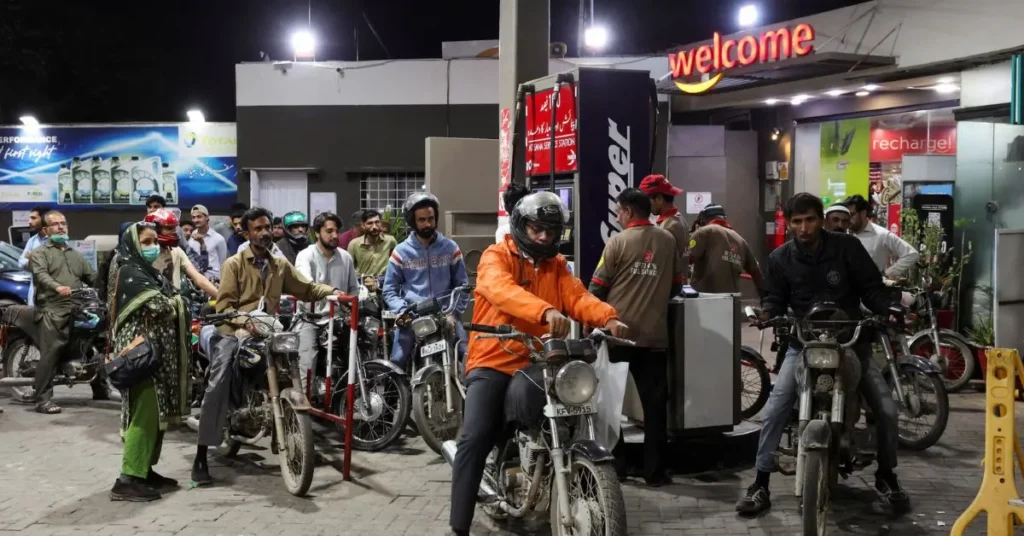
ISLAMABAD (Kashmir English): The federal government’s fuel relief scheme for motorcycles, rickshaws and small cars may end after the International Monetary Fund (IMF) called for the “prompt” phase-out of the government’s petrol subsidy program.
It came after the IMF said it reached a staff-level agreement with Pakistani authorities on the fourth review under the $7 billion Extended Fund Facility (EFF) and the third review under the $1.4bn Resilience and Sustainability Facility (RSF).
The press release stated that Pakistan has qualified to draw about $1.2 billion from the Fund’s resources within four to five weeks, and the staff-level agreement is subject to approval by the IMF Executive Board.
“Upon approval, Pakistan will have access to about US$1.0 billion (SDR 760 million) under the EFF and about US$210 million (SDR 154 million) under the RSF, bringing total disbursements under the two arrangements to about US$5.7 billion,” it stated.
The statement was issued by mission chief Iva Petrova after an International Monetary Fund (IMF) team held discussions on the fourth review under the Extended Fund Facility and the third review under the Resilience and Sustainability Facility in Karachi and Islamabad from September 23 to October 7, 2026.
In a statement, the Fund said that Islamabad has agreed to phase out the fuel support scheme promptly, given its high cost and broad targeting.
“Any future fuel support — should oil prices surprise on the upside — should be limited, time-bound, targeted using established social assistance programs, and accommodated within the FY27 budget envelope,” it said.
“Other government priorities include bringing improvements in social and health sector spending, and enhancing governance of the state-owned companies,” the IMF said.
“Pakistan’s economic program on track”
The IMF said Pakistan’s economic program had remained broadly on track despite the challenging external environment, with authorities committed to maintaining fiscal discipline, controlling inflation, strengthening the energy sector and advancing structural reforms.
“Supported by the EFF, the authorities have successfully navigated the impact of the Middle East conflict, and strong policies have helped preserve macroeconomic stability,” it stated.
“Real GDP growth reached 4 percent in the first three quarters of FY26, and although higher energy prices and supply disruptions weakened the momentum somewhat, FY26 growth is estimated at 3.6 percent. Headline inflation, after peaking in May, moderated to about 10.3 percent in September, while core inflation remained contained.
“The current account was broadly balanced in FY26, supported by strong remittances, and gross reserves rose to about US$21½ billion by end-September. Sovereign rating upgrades and renewed international market access also point to stronger policy credibility. Nevertheless, risks remain high, particularly from geopolitical tensions, volatile energy prices, tighter global financial conditions, and trade disruptions.”
The statement added that Pakistani authorities, supported by the RSF, are continuing efforts to strengthen resilience to climate change, with recent progress in mainstreaming climate considerations into public investment planning and strengthening disaster risk financing and coordination.
“Further reforms are advancing on irrigation water pricing and collection, better-targeted electricity subsidies, energy-efficiency standards, and transport decarbonization,” it concluded.