MUZAFFARABAD (Kashmir English): October 27 marks the darkest day in Kashmir’s history, the date on which India occupied a large portion of Jammu and Kashmir against the will of the Kashmiri people.
As in previous years, Kashmiris living on both sides of the Line of Control and across the globe will observe October 27 as a ‘Black Day’ to register their protest against the Indian occupation.
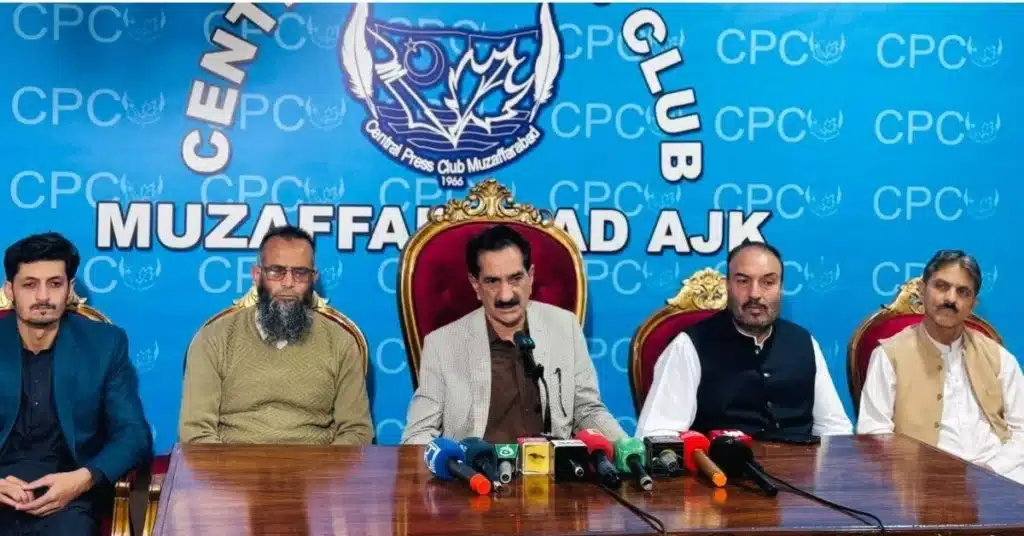
These remarks were made by Parvez Ahmad Shah Advocate, General Secretary of the APHC-AJK; Uzair Ahmed Ghazali, Chairman of Pasban-e-Hurriyat Jammu and Kashmir; Shahzad Lolabi, General Secretary of the Central Press Club; Hurriyat leader Raja Shaheen; and Muhammad Haroon of the Liberation Cell while addressing a press conference at the Central Press Club in Muzaffarabad.
They stated that October 27, 1947, was the darkest day in Kashmir’s history, as India deployed its troops against the wishes of the Kashmiri people and initiated the military occupation of Jammu and Kashmir.
They said the Kashmiri people had been struggling against this illegal occupation for the past 79 years and that their struggle would continue until they secured their right to self-determination.
Advocate Parvez Shah, shedding light on the historical background of the Kashmir dispute, stated that at the time of the partition of the subcontinent, Jammu and Kashmir held a distinct status, and its future should have been decided in accordance with the aspirations of the Kashmiri people and the principle of self-determination.
He noted that the arrival of Indian forces on October 27, 1947, gave rise to a conflict in the region that remains unresolved to this day.
HRs situation in occupied Kashmir
Shah emphasized that the human rights situation in occupied Kashmir, political restrictions and concerns regarding the identity of the Kashmiri people demanded global attention.
He further said Pakistan had played a significant role in highlighting the Kashmir dispute internationally and supporting the Kashmiris’ right to self-determination.
Uzair Ahmed Ghazali remarked that October 27 was a ‘Black Day’ for Kashmiris because the Indian military intervention on that date disregarded the free will of the people of Jammu and Kashmir.
He asserted that the history of Kashmir, the circumstances surrounding the partition of the subcontinent and subsequent events indicated that a just resolution of the Kashmir dispute was possible only in accordance with the aspirations of the Kashmiri people.
Uzair Ahmed Ghazali said India had taken various political, constitutional and administrative measures to perpetuate its occupation of Kashmir.
He added that concerns over changes in the region’s demographic composition had intensified following the events of August 5, 2019.
He urged media representatives to play their part in highlighting the Kashmir dispute, amplifying the voice of the Kashmiri people internationally and bringing human rights concerns to the forefront.
Shahzad Lolabi said in his address that the Kashmir dispute was not merely the concern of a single party or organization but a collective issue for the entire nation.
He added that the struggle of the Kashmiri people, their sacrifices and Pakistan’s support had played a pivotal role in keeping the dispute on the international agenda.
He urged the journalistic community to report responsibly on Kashmir by highlighting developments in the occupied territory and the challenges faced by its people.
Hurriyat leader Raja Shaheen said the Kashmiri people had waged a long struggle for their fundamental rights and the right to self-determination.
He asserted that India’s actions in occupied Kashmir could not determine the political future of the Kashmiri people. A lasting resolution of the dispute, he said, was possible only through adherence to United Nations resolutions and respect for the free will of the Kashmiri people.
Azad Kashmir government spokesperson Muhammad Haroon stated that the Kashmir issue was a national and collective matter.
He said the governments of Pakistan and Azad Kashmir continued to support the Kashmiri people’s right to self-determination.
He appealed to the public to participate actively in the activities scheduled for October 27 and express solidarity with the people of occupied Kashmir peacefully.
On the day, black flags will be hoisted, protest demonstrations held and rallies organized. In the capital, Muzaffarabad, a ‘Black Day’ rally and demonstration will be staged under the joint auspices of the All Parties Hurriyat Conference (APHC) and the Liberation Cell.