
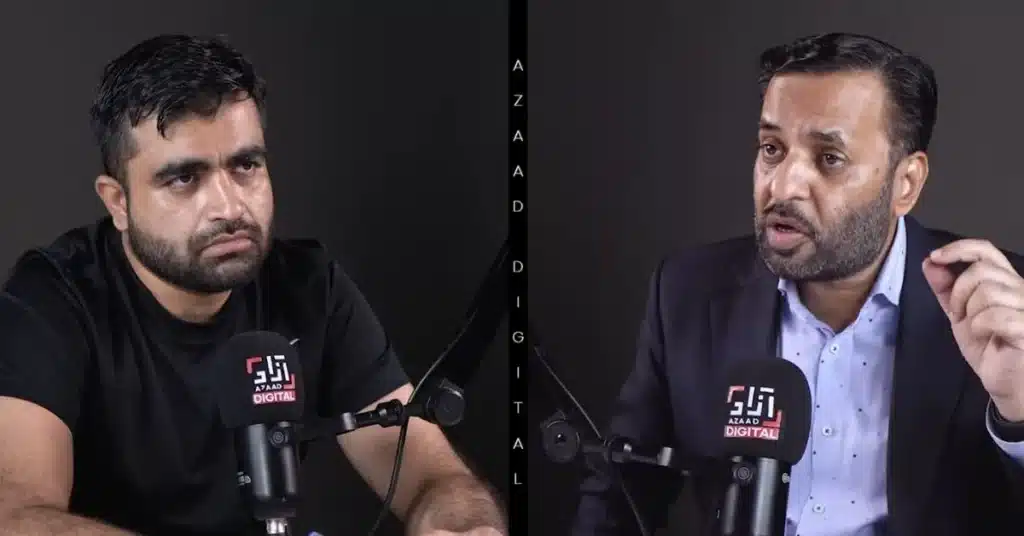
ISLAMABAD (Kashmir English): Federal Health Minister Mustafa Kamal has strongly supported the creation of new administrative units and provinces and powers for local government in Pakistan, arguing that the country’s existing four-province structure no longer corresponds to its growing population and administrative needs.
In an exclusive interview with Azaad Digital on Tuesday, Mustafa Kamal discussed various important issues, including the development of Karachi, the local government system, the establishment of new administrative units and provinces, the PPP’s stance, constitutional amendments, the financial resources provided to Sindh, the prices of medicines, and his political tenure.
Referring to Article 140-A of the Constitution, Kamal said local governments should be given constitutionally protected powers to ensure effective governance at the grassroots level.
He stressed the need to strengthen local government institutions and devolve authority closer to citizens, arguing that improved local governance was essential for better service delivery, accountability and sustainable development.
Mustafa Kamal, while strongly supporting the establishment of new administrative units and provinces, said that the administrative structure of the current four provinces was no longer in line with the current population and needs of the country.
He said that when Pakistan was established, the country’s population was about 37 million and there were four provinces, but today the population has exceeded 260 million and the same four provinces still exist administratively.
He said that Punjab, Sindh, Khyber Pakhtunkhwa, and Balochistan are larger than many countries in the world in terms of area, so it is necessary to create new units for administrative convenience and access to power for the people.
Giving examples of different countries, including India, Kamal said that with the increase in population and administrative needs, new provinces and administrative units were created in many countries of the world.
He also referred to countries including Turkey, Iran, Afghanistan, and the United States, saying administrative structures should evolve according to population and governance needs.
PPP’s stance and constitutional amendments
Criticizing the Pakistan Peoples Party’s position on the issue, Kamal said the establishment of new provinces was neither unconstitutional nor an unprecedented demand.
He said the Constitution of 1973 already provided a legal and constitutional procedure for the creation of new provinces.
“The Constitution is not a document that cannot be amended according to changing circumstances,” Kamal said, adding that several constitutional amendments had been introduced in Pakistan over the decades to address evolving national requirements.
Moreover, he rejected the argument that the creation of new administrative units would amount to the division of Sindh. He said administrative restructuring and the historical or cultural identity of a province were separate issues.
He gave the example of Karachi and said that Karachi was divided from one district into seven districts due to administrative necessity, but this did not end Karachi or the identity of Sindh.
Mustafa Kamal added that just as more rooms or floors are built in a house when it grows, similarly, administrative units can be built when the population increases.
Claims about Sindh’s financial resources
While criticizing the Sindh government, a federal minister claimed that the province had received approximately Rs 22 trillion over the past 18 years but continued to face serious shortages of basic facilities in both urban and rural areas.
He referred to conditions in parts of interior Sindh, claiming that some communities lacked access to clean drinking water and that the health and education sectors continued to face major challenges.
Kamal argued that the continued absence of basic public services despite substantial financial resources raised serious questions about the existing governance and administrative system.
He said that despite receiving such huge financial resources, if the people are deprived of basic facilities, then the current administrative and governance system is questioned.
Recalling his tenure, Mustafa Kamal said that he spent about Rs 300 billion in a very honest and transparent manner.
The minister added that the basic principle of his strategy was to remain free from corruption, have pure intentions, and do practical work at the grassroots level. According to him, as a result of this strategy, Karachi became one of the 12 fastest growing cities in the world, while today despite such huge resources, the city is facing the worst problems.
In addition, Mustafa said that the creation of new administrative units will allow resources to be spent at the local level, and the people will be able to directly question their elected representatives.
“In the current system, a few specific people rule the entire province, while ordinary citizens do not have an effective administrative channel to directly change them.”
He stated that small administrative units will increase the accountability of public representatives, and the pace of development work will also accelerate.