
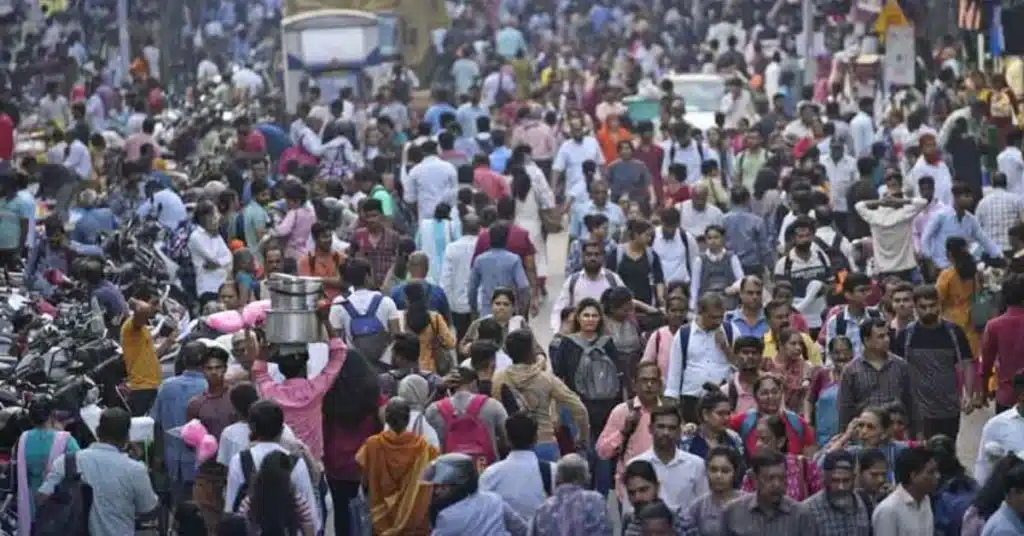
NEW DELHI (Kashmir English): With 1.42 billion people, India is already among the world’s most populous countries but powerful allies of Prime Minister Narendra Modi are championing larger families to counter a declining fertility rate.
Even though the United Nations has projected India’s population will keep rising for about four decades, peaking at around 1.7 billion, some Hindu groups and policymakers say the shift away from smaller families should begin now, including through government financial support.
The state of Andhra Pradesh is offering one-time cash incentive for third, and fourth children.
The average number of children per woman in India declined to 2 in the 2019/21 government assessment period, down from 3.4 in 1992/93, due to increasing use of contraceptives and rising education among females.
According to the government estimates, a rate of 2.1 is required for the population to replace itself.
Andhra Pradesh, the southern state of the country, ruled by a coalition of a regional party and Modi’s party, said over the weekend it would offer a one-time cash incentive of 30,000 rupees ($311.57) for a third child and 40,000 rupees for a fourth, revising an earlier proposal for 25,000 rupees for a second child and no direct support for a first-born. It did not say when the plan will be implemented.
Chief Minister Chandrababu Naidu views that falling birth rates in many countries were leading to ageing populations and economic strain.
“In the past, we worked extensively on family planning,” he said. “Now, given the changed circumstances, we are calling for children to be seen as wealth.”
The small northeastern state of Sikkim has also urged families to have more children, offering incentives such as year-long maternity leave, month-long paternity leave and financial support for in-vitro fertilisation.
The UN says that in the mid-1980s, China, Japan, South Korea, Thailand and Turkey all deeming their birth rates too high tried to bring them down, only to change course by 2015 to promote policies to boost births.
A powerful Hindu group, the Rashtriya Swayamsevak Sangh (RSS), from which Modi’s party emerged, has also called for bigger families, describing it as a priority.
“We say that India is a country of youngsters … but slowly, the TFR is coming down,” RSS General Secretary Dattatreya Hosabale told reporters last week. “Demographic imbalances will create tensions.”
India’s overall unemployment rate
Government data shows that India’s overall unemployment rate for those aged 15 and above was 3.1% in 2025, but among those aged 15 to 29 was much higher at 9.9%, including 13.6% in urban areas and 8.3% in rural regions.