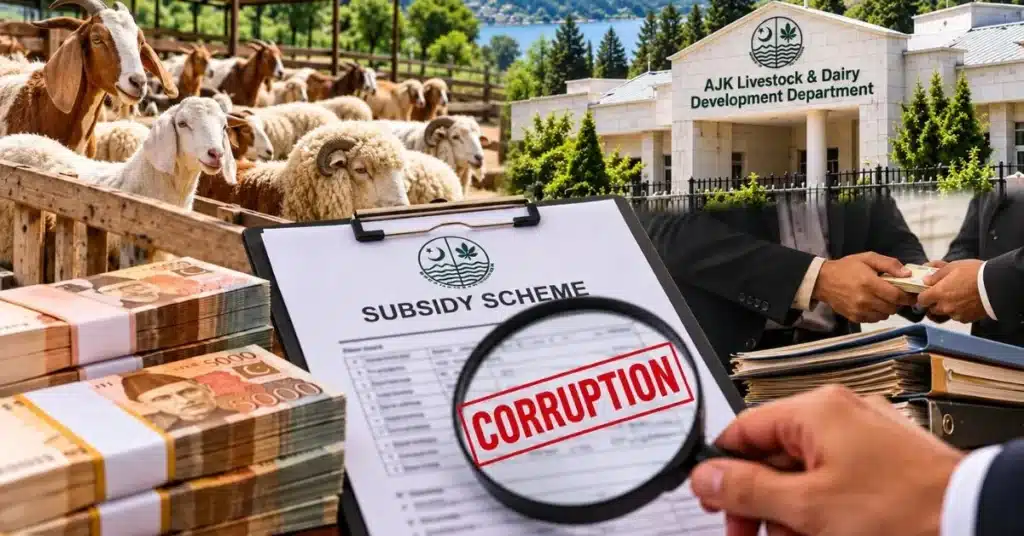
BHIMBER (Kashmir Digital): The Azad Jammu and Kashmir (AJK) government’s livestock subsidy programme has come under scrutiny after a monitoring team uncovered corruption worth millions of rupees in the ‘Sheep and Goat Development Programme’ in Bhimber district.
As per the details, the AJK Livestock and Dairy Development Department introduced the programme in 2023, aimed at raising the standard of rural development by breeding the best breeds of sheep and goats and generating employment opportunities for farmers.
Under the scheme’s PC-I document, three subsidy categories were established: Rs200,000 for Category A, Rs400,000 for Category B and Rs600,000 for Category C.
According to the report, available with Kashmir Digital, the Livestock Department advertised the scheme and received 104 applications across the district.
However, the report, issued by the Directorate of Animal Health & Veterinary Services Muzaffarabad, alleged that financial assistance was ultimately distributed among just 14 farmers, with 11 of them belonging to Kadiala village in Bhimber’s Samahni tehsil.
Besides the 11 beneficiaries from Kadiala, one farmer was from Bhimber tehsil and two from Patni village in Barnala Tehsil.
Of the 14 reported beneficiaries, eight farmers were listed under Category A, four under Category B, and two under Category C.
Irregularities exposed
The report also noted that no evidence of a balloting process could be found, raising questions about how beneficiaries were selected. It raised the question of how eleven people from the same village were drawn.
The monitoring team also said that it found tampering in the register. “When it was checked, it was clearly seen that deserving beneficiaries’ names had been erased and replaced with favourites,” it added.
During inspections of the selected farmers’ livestock facilities, the team reportedly found only three to four local-breed goats at some houses.
“The District Livestock and Poultry Development Authority was responsible for ensuring that those 14 people who have received Rs4.4 million in total should have tagged livestock,” it stated.
The report also stated that the sheep and goats were purchased from a single vendor, questioning whether one seller could have supplied the reported requirement of around 300 animals at the same time.
The findings have raised concerns about beneficiary verification, livestock procurement, and the use of public funds under the scheme.