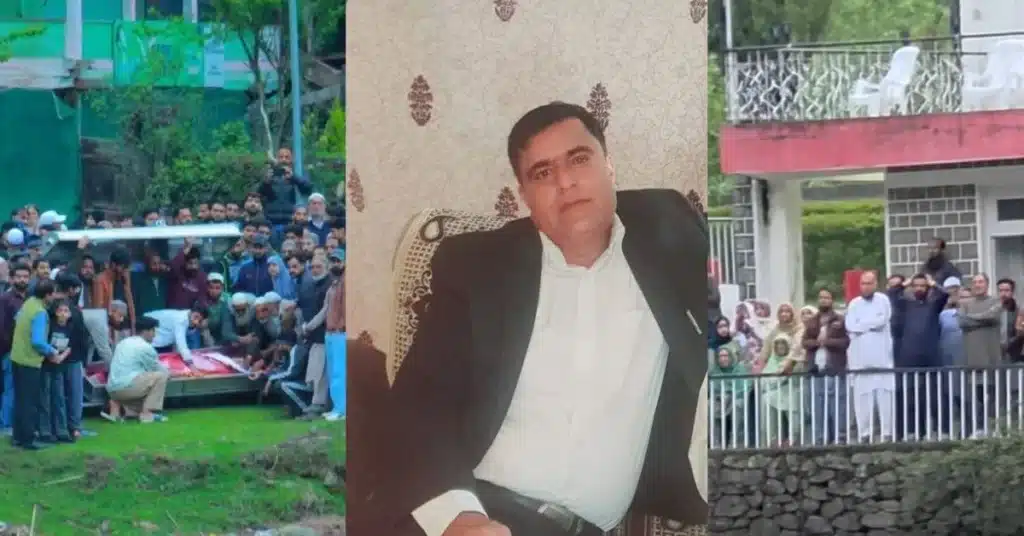
NEELUM (Kashmir English): In a heart-wrenching incident along the Line of Control (LoC), the funeral of a Raja Liaquat Ali Khan was held in Indian occupied Kashmir, while his family watched helplessly from Azad Kashmir’s Keran village across the Neelum River, to catch his one final glimpse.
The incident, videos of which went viral on social media, has highlighted the continued hardships faced by divided families in Kashmir.
As per details, Raja Liaquat Ali Khan, a resident of Kupwara district in IIOJK, passed away in a hospital in Srinagar. He had been living alone in the region since 1989, when his family migrated to Azad Jammu and Kashmir.
Following his death on April 25, funeral prayers were held in Kupwara’s Keran, a village that lies on both sides of the LoC, on the bank of the Neelum River. However, due to restrictions, his maternal and paternal relatives living across the border were unable to attend the funeral.
His sisters and other family members gathered on the opposite side of the riverbank in Keran in Neelum Valley, watching from a distance as Liaquat Ali’s last rites were performed.
The videos of his family members crying helplessly from just meters away have shown that the border doesn’t just divide land, it shatters hearts.
The deceased’s cousin, Mumtaz Khan, living in Azad Kashmir, wrote on Facebook, “No one understands the pain of divided families at the LoC better than those who have faced the heart-wrenching experience of being unable to view and attend the final prayer (Janaza) of their departed loved ones (Late Liaquat Ali Khan) for merely a hundred meters away.”
Pasban-e-Hurriyat slams India for seperation of families
Chairman Pasban-e-Hurriyat, Uzair Ahmad Ghazali, has said that India has militarily occupied a vast geographical portion, population, and resources of the State of Jammu and Kashmir and has torn the state into two parts.
In a statement shared after Liaquat Ali Khan’s funeral, Ghazali said India has no concern for the rights, freedom, and lives of the Kashmiri people; rather, it is only interested in usurping the land of the state.
He stated that if there is even a trace of democratic or human conscience left in India, it should announce a free, fair, and impartial plebiscite in Jammu and Kashmir.
“The truth is that the people of Jammu Kashmir seek complete freedom from India’s oppressive rule,” he asserted.
Ghazali said India is responsible for subjecting millions of people in Jammu and Kashmir to fear, suffering, and perpetual insecurity.
Referring to the body of Raja Liaquat Ali Khan placed on the bank of the river in Keran, and the wailing sisters in Azad Kashmir mourning their brother from across the river, he said the scene was a silent yet powerful referendum against Indian brutality, repression, and the division of Kashmir.
He said that since India’s military occupation of Jammu and Kashmir in 1947, the Kashmiri people have been subjected to continuous hardships, oppression, and trials.
“During 1947, 1965, and 1971, millions of Kashmiris were forced to migrate from Jammu and other areas, while after 1947, Indian occupying forces committed crimes against humanity in occupied Jammu and Kashmir that have become part of living history.”
Thousands of families were compelled to cross the bloodline and migrate to Pakistan, which stands as clear testimony to Indian tyranny and repression, he stated.
Uzair Ahmad Ghazali urged the United Nations to play an immediate and effective role in resolving the smouldering Kashmir dispute between the two nuclear powers.
He also called upon the international community, human rights organizations, and justice-loving forces to raise their voice for ending Indian war crimes in occupied Jammu Kashmir and for protecting the fundamental rights of millions of Kashmiris living across the Line of Control.
The activist maintained that the Kashmir dispute is not merely a territorial conflict but a human, political, and moral issue, and its only just solution lies in granting the people of Jammu Kashmir their birthright, a free and impartial plebiscite.