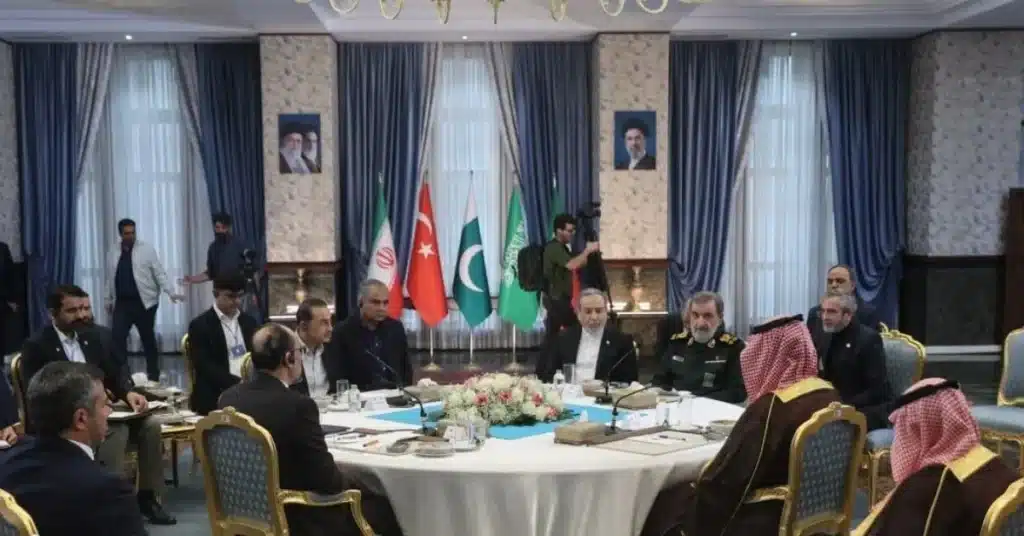
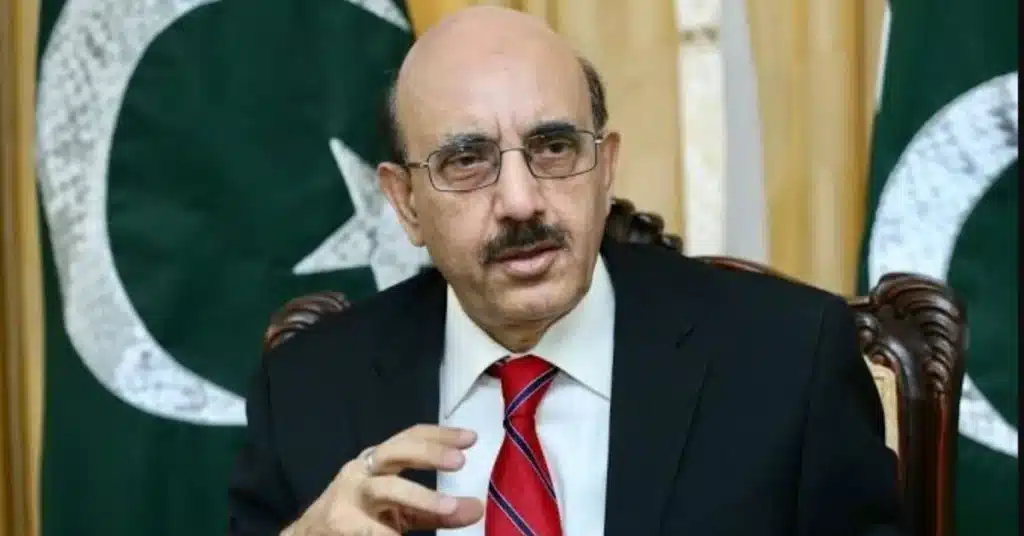
ISLAMABAD (Kashmir English): Former president Azad Jammu and Kashmir Sardar Masood Khan has said that the Makkah Defence Alliance should gradually expand its membership to include more Gulf states and other Muslim countries to strengthen collective security, promote regional cooperation and develop greater self-reliance in defence.
Sardar Masood Khan, speaking in a television interview, said Qatar, Kuwait and Bahrain could be considered for inclusion, alongside Egypt, Indonesia and Malaysia.
He observed that several Muslim countries have strong historical and strategic connections with Pakistan, Türkiye and Iran, providing a foundation for broader cooperation.
He was of the view that membership could be expanded either quickly or in phases, while the alliance consolidates its institutional arrangements and establishes its Secretariat.
He stressed that the current regional conflict had created a compelling need for Muslim countries to strengthen their collective defence capabilities.
However, he cautioned that the momentum for cooperation could diminish if hostilities ended without a sustained institutional framework.
Referring to recent engagements involving the alliance and Iran, Khan said the meetings had helped address misconceptions and build trust.
He noted that regional countries increasingly recognised the importance of taking greater responsibility for their own security rather than relying exclusively on external powers.
On the escalating tensions involving Saudi Arabia and Yemen’s Houthi movement, Khan said an essential test of regional diplomacy was an immediate end to Houthi attacks against Saudi Arabia.
Makkah Alliance
He described these attacks as a red line for Saudi Arabia and the Makkah Alliance, warning that the widening conflict around the Bab al-Mandab Strait could damage the international economy and adversely affect Gulf states, the wider Middle East and North Africa, and Europe.
Masood Khan maintained that Iran possessed significant influence over the Houthis and could use that influence to encourage a cessation of attacks, even though the movement retained operational autonomy.
He said Tehran’s willingness to facilitate dialogue between the Houthis and Saudi Arabia reflected its capacity to contribute to de-escalation.