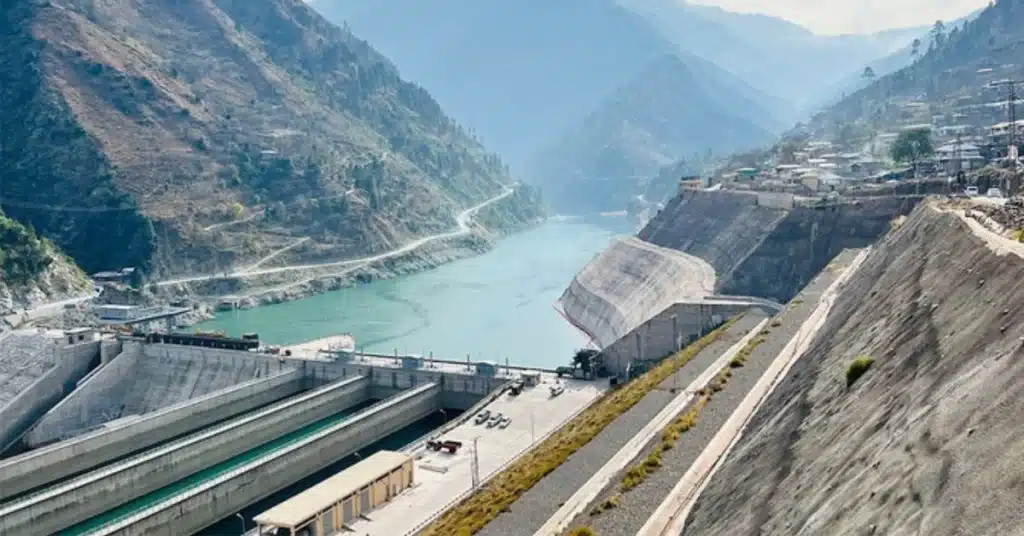
ISLAMABAD (Kashmir English): The Senate Standing Committee on Water Resources has been informed that the Neelum-Jhelum Hydropower Project (NJHP), which was shut down due to a tunnel fault, may resume power generation by March 2028 after a shutdown of about 4 years.
The committee, chaired by Senator Jam Saifullah Khan, questioned the status of the 969 megawatt Neelum-Jhelum Hydropower Project after Rs508 billion had been spent on a scheme that is currently lying idle.
The Chairman WAPDA, Lt. Gen. (retd) Muhammad Saeed, told the committee that despite the tunnel problems, the NJHP has been a successful project and has already recovered about 80 percent of its cost through the provision of cheap electricity.
He described Neelum-Jhelum as a unique project whose operation depends entirely on its tunnel system. He acknowledged that concerns had existed since the project’s inception, but said Pakistan had to establish its water rights over the Neelum River while competing with India over the project.
He further said that an investigation into the tunnel malfunction is underway, adding that WAPDA is committed to restoring the project, and power generation will resume by March 2028.
The Senate committee stressed that there should be a transparent and independent inquiry into the causes of the tunnel collapse and the cost escalation of the project.
Senator Saifullah assured the officials of the Ministry of Water Resources that the committee would fully support an impartial investigation to ensure the protection of future national infrastructure and accountability.
Chairman WAPDA also revealed a fraud of Rs23 billion in the Nai Gaj Dam project. He said that in 2009, the original contractor had submitted a fake bank guarantee, which caused a financial loss of about Rs23 billion to the national exchequer.
He said that now the contract of the said contractor has been cancelled and blacklisted, and the matter is currently under hearing in the Supreme Court.
The committee, while endorsing the ministry’s stance, stressed ensuring accountability and early completion of the project, which has the capacity to irrigate 28,000 acres of land.
Water challenges
The WAPDA chairman warned that Pakistan will have to take water challenges seriously for its survival, as it has become one of the most water-stressed countries in the world.
He regretted that after the construction of Mangla and Tarbela dams, no major dam has been built in Pakistan for the last 5 decades. On the contrary, neighboring country India has built thousands of small and large dams during this period.
Furthermore, the committee was given a detailed briefing on the declining groundwater level across the country.
Excessive water extraction is going on in several districts, including Okara, Vehari, Sahiwal, Multan, and Lahore, due to which the water level has fallen to dangerous levels, the WAPDA official said.
The committee directed to adopt international methods of water conservation and modern irrigation techniques to protect agriculture.
Provincial officials said that 80 percent of Sindh’s groundwater has become saline (salty). A draft legislation regarding groundwater is being prepared in the province. Senator Saifullah directed the Sindh government to present the draft before the committee for review.
The committee was also given updates on several other major water projects, including Hingol Dam, Harpo Dam, Kachhi Canal, RBOD-I, and RBOD-III, and issues related to Sem and Thor.
While reviewing the funds of the Public Sector Development Program for the current financial year, the committee expressed deep concern over the acute shortage of funds for water and power projects.