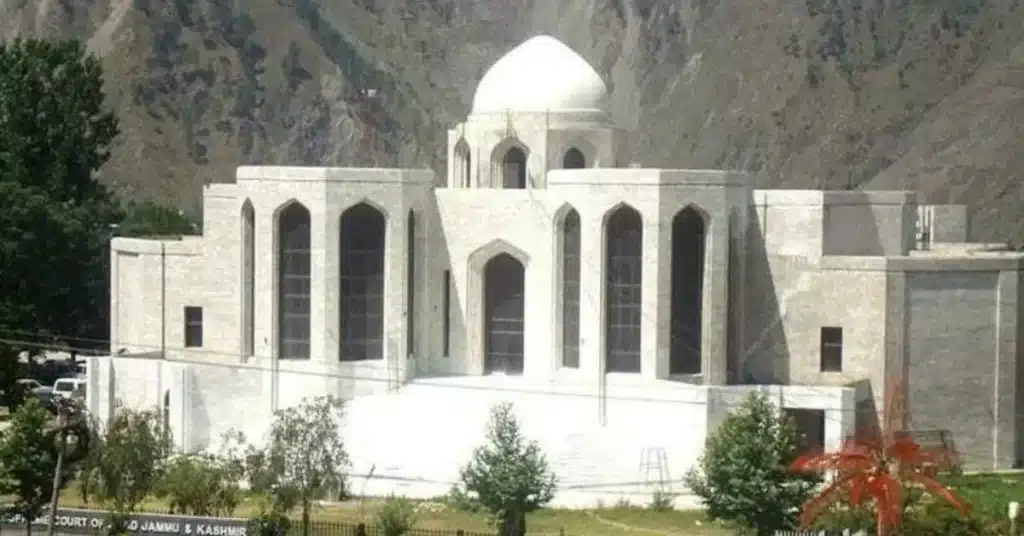
MUZAFFARABAD (Kashmir English): The Supreme Court of Azad Jammu and Kashmir has completed the hearing of the Presidential Reference filed by the Azad Jammu and Kashmir government regarding the constitutional and legal future of 12 seats reserved for refugees of Jammu and Kashmir in the Legislative Assembly and reserved its decision.
A bench comprising Chief Justice of Azad Jammu and Kashmir Justice Raja Saeed Akram Khan and Justice Khalid Yousuf Chaudhry reserved the decision after hearing detailed arguments on various constitutional, legal and public importance points on refugee seats reference.
The decision will be sent to President of the Azad Jammu and Kashmir.
During the hearing, the court obtained the opinions of judicial assistants and senior lawyers on various constitutional questions raised in the refugee seats reference.
Hearing on the Presidential Reference
Senior lawyer Raja Sajjad Ahmed Khan, as a judicial assistant, took the position that under Article 33 of the Interim Constitution of Azad Jammu and Kashmir, the Legislative Assembly has full legislative power and the issue of refugee seats should have been considered in the forum of the High Power Committee.
He also presented the reference of the negotiations between the Federal Committee and the Joint Public Action Committee before the court.
Barrister Humayun Nawaz, Raja Sadaqat Hussain and Sardar Abdul Raziq, among other jurists, also presented their legal points. During the hearing, former Prime Minister Raja Muhammad Farooq Haider Khan, former Minister Chaudhry Muhammad Rashid and Member of Legislative Assembly of the Refugee Seat Abdul Majid Khan appeared in the court in their personal capacity.
What’s in the Reference
The reference filed by the Azad Kashmir government has asked the court whether the 12 reserved seats for refugees have constitutional protection under Articles 22, 33 and 57 of the Azad Kashmir Constitution and whether any change or abolition in them is possible only through a constitutional amendment.
The court has also sought guidance on whether the demand for the abolition of these seats through public pressure, protests, sit-ins or threats of road blockade can be declared constitutionally legitimate.
The reference further raises the question of whether the current Legislative Assembly, which is about to complete its constitutional term, is authorized to make such a fundamental constitutional amendment or should such a decision be taken by the newly elected Assembly.
The government has also taken the position that any attempt to change constitutional provisions through force, pressure or intimidation may amount to a violation of the constitutional order and may have implications for the unitary identity of the state of Jammu and Kashmir, its accession to Pakistan and the international position on the Kashmir issue.
The government has also sought guidance from the court in the context of fundamental rights as to whether the freedom of protest and assembly can be used for such demands that are aimed at disrupting elections or making changes outside the constitutional process. It has also been questioned whether the government is bound to take all legal steps to hold elections within the constitutional period, maintain law and order and protect state order.
According to the reference, 12 out of 53 seats in the Legislative Assembly are reserved for refugees from occupied Jammu and Kashmir, of which six seats are reserved for the Kashmir Valley while six seats are reserved for the Jammu region and Mangla Dam victims. According to the government, these seats represent millions of refugees as well as a symbol of the state of Jammu and Kashmir’s historical stance of unitary identity and right to self-determination.
The government informed the court that the Joint Public Action Committee is demanding the abolition of refugee seats and there is a risk of the electoral process and normal life being affected due to protest movements and announcements of strikes in this regard.
In support of its position, the government has sought clear constitutional guidance from the Supreme Court to protect constitutional supremacy, electoral process and state stability, citing the Constitution of Azad Kashmir and various judicial precedents.
Justice Raza Ali Khan Recused
It should be noted that the senior-most judge of the Supreme Court, Justice Raza Ali Khan, had recused himself from hearing the case, due to which a two-member bench heard the reference. After the arguments of all the parties and judicial assistants were completed, the Supreme Court has reserved its decision on the presidential reference, which is eagerly awaited by political, legal and public circles.
According to experts, the court’s opinion or decision could have far-reaching effects on the refugee seats, the upcoming general elections, and the constitutional and political system of Azad Jammu and Kashmir.