
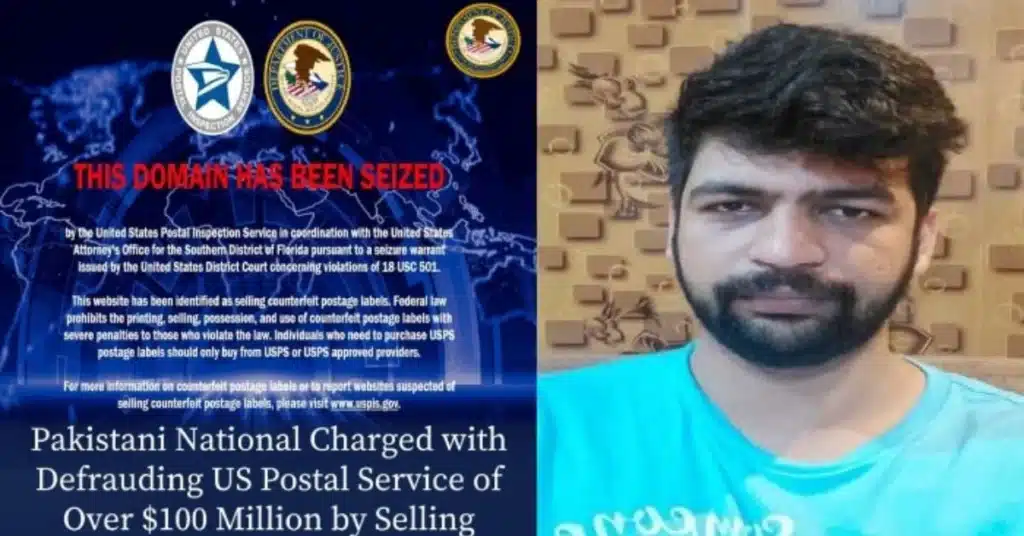
LAHORE (Kashmir English): The National Cyber Crime Investigation Agency (NCCIA) has arrested an accused in a major online fraud worth Rs35 billion involving the sale of counterfeit US postal stamps.
Faheem Akram, a resident of Khanewal, was indicted in a federal court in the US state of Florida on charges of defrauding the US Postal Service of $126 million.
The US Department of Justice had said that Faheem Akram had created a website called LabelsBank.com that sold more than 5.1 million counterfeit shipping labels to thousands of customers. The accused sold each parcel stamp for just $2, regardless of the weight and size of the parcel.
It was further reported that more than 5,200 users purchased fake stamps from the website.
According to an NCCIA spokesperson, the 33-year-old Faheem Akram operated a fake website to sell counterfeit US postal stamps from 2023 onward. The official said more than five million fake stamps had reportedly been sold through the platform.
He further stated that 16 bank accounts belonging to members of the suspect’s family were used in the transactions.
“A special operation to trace and arrest the suspect continued for 10 days, during which investigators questioned 47 people and analysed 122 call records,” he added.
The operation was conducted by eight special teams under the supervision of Additional Director Atif Amir. Raids were carried out at 35 locations across Punjab, Islamabad and Sindh, the spokesperson said.
Moreover, he added that a case has been registered in this regard and further investigations are underway.
Director General NCCIA Syed Ali Nasir Rizvi said that a zero-tolerance policy is being implemented against elements involved in cybercrime and digital fraud, urging the public to report such fraud on helpline 1799.
According to the US Justice Department, Akram faces one count of conspiracy to defraud the United States and to make and sell counterfeit postage stamps, five counts of making and selling counterfeit postage labels, and four counts of wire fraud.
“If convicted, he faces a maximum sentence of five years in prison on the conspiracy and counterfeit-postage counts and up to 20 years on each wire-fraud count,” according to the Justice Department.