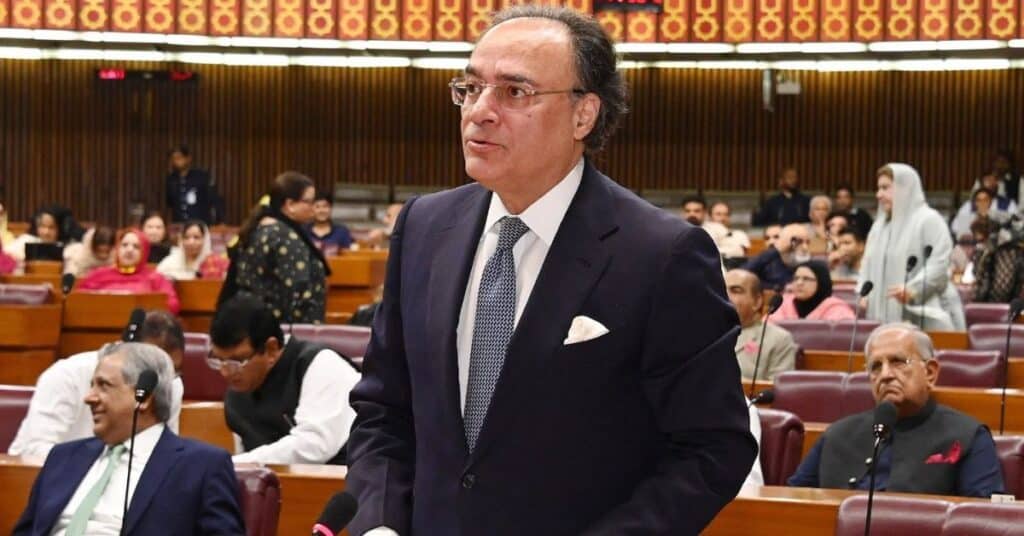
ISLAMABAD (Kashmir English): The National Assembly on Tuesday passed the Budget 2026-27 after a clause-by-clause consideration by rejecting all the amendments presented by the opposition, state-run APP reported.
Minister for Finance and Revenue, Senator Aurangzeb moved the motion for consideration of the Finance Bill 2026, to give effect to the financial proposals of the federal government for the year, commencing on July 1, 2026.
The motion was passed with a majority vote, which led to the passage of the Finance Bill-2026 after a clause-by-clause reading.
The total outlay of the federal budget for the fiscal year 2026–27 is Rs 18.77 trillion. The budget outlines a comprehensive fiscal framework aimed at strengthening macroeconomic stability, enhancing exports, improving foreign exchange reserves, reducing fiscal imbalances, and promoting sustainable economic growth.
The budget projects an economic growth rate of 4.0% for the fiscal year 2026–27. Inflation is expected to remain at 8.2%, while the fiscal deficit has been estimated at 3.6% of GDP and the primary surplus is projected to reach 2.0% of GDP.
Revenue collection set at Rs15.2 trillion
The revenue collection target by the Federal Board of Revenue (FBR) has been set at Rs 15.264 trillion, reflecting an increase over the previous fiscal year.
Net federal revenues are estimated at Rs.11.752 trillion whereas total expenditures have been projected at Rs 18.77 trillion. Out of these expenditures, around Rs 8.05 trillion will be spent on debt servicing and markup payments.
An amount of Rs 1 trillion has been earmarked for the Federal Public Sector Development Programme (PSDP), while the overall national development programme is estimated at approximately Rs 3.675 trillion.
In addition, substantial allocations have been made for pensions, civil administration, subsidies, and social protection programmes. Likewise, Rs 838 billion has been allocated for the Benazir Income Support Programme (BISP), representing a significant increase from the previous year.
The enhanced allocation is aimed at expanding social protection coverage and increasing financial assistance to vulnerable households. The government intends to further strengthen the flagship initiatives of the Benazir Income Support Programme by expanding its outreach and improving support mechanisms for low-income families.
Increase in salaries, pensions
The budget proposes a 7% increase in salaries of government employees and a corresponding increase in pensions, while additional relief measures have also been announced for public sector employees and armed forces personnel.
Meanwhile, various tax reforms and relief measures have been introduced in the budget to broaden the tax base, improve compliance, and support economic growth. The government has maintained its focus on minimizing the tax burden on lower-income groups while increasing contributions from higher-income segments and under-taxed sectors.
As per the Finance Bill, several measures relating to taxation, energy reforms, digital economy regulation, and investment facilitation have been proposed to improve fiscal sustainability and enhance competitiveness.
The government has also announced policy initiatives aimed at industrial development, promotion of electric vehicles, export enhancement, energy sector reforms, and investment facilitation to achieve long-term economic growth.
It is pertinent to mention here that the budget for fiscal year 2026–27 is a balanced fiscal plan focused on economic stabilization, revenue enhancement, social protection, export promotion, fiscal discipline, and sustainable development, to foster inclusive growth and strengthen Pakistan’s economy.