
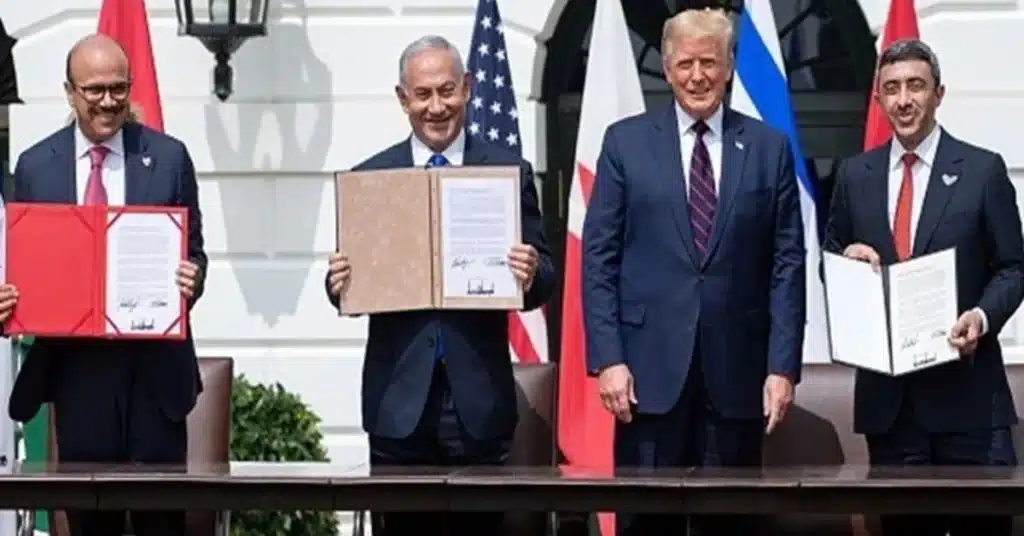
WASHINGTON (Kashmir English): Efforts to end the US-Iran conflict continue amid slim hopes of the parties reaching an agreement, while President Trump has again called on Muslim countries to accept the Abraham Accords.
In a statement on Truth Social, US President Donald Trump has called on Muslim countries to accept and sign the Abraham Accords.
Trump said that Saudi Arabia, Qatar, Pakistan, Turkey, and other countries should sign the Abraham Accords, starting with Saudi Arabia and Qatar.
“It is possible that one or two countries may have a reason not to join the Abraham Accords, and that should be accepted.”
The US President stated that for the countries that sign the agreement, it would prove to be a revolution in financial, economic, and social development.
This would be a document respected more than any other document signed in the world to date.
Abraham Accords
The US concept of a major reconciliation between Muslims, Jews, and Christians emerged in 2020.
Its fundamental idea was to bring about reconciliation between the three major religions, especially in the Muslim world and Israel, and that is known as the Abraham Accords.
The Abraham Accords were established in 2020 during US President Donald Trump’s first term. The Accords are a set of agreements aimed at normalizing relations between Israel and several Arab countries.
Its purpose is to open embassies, establish economic and security relations between Israel and Muslim countries, especially Arab countries, in each other’s countries in the Middle East.
The Abraham Accords began with the establishment of relations between the United Arab Emirates and Bahrain with Israel. After the UAE and Bahrain, Morocco and Sudan also signed agreements to normalize relations with Israel.
Last year, US President Donald Trump announced that Kazakhstan had also officially joined the Abraham Accords.
Israel saw this as a major step in its diplomatic acceptance in the Arab world, but for the Palestinian leadership and many Muslim countries, the fundamental question remained: what about the Palestinian issue?
Pakistan’s official and constitutional stance has consistently been that Israel cannot be recognized until Palestinians achieve an independent and sovereign state within the pre-1967 borders, with Al-Quds Al-Sharif as its capital.
Pakistan’s position is considered not only diplomatic but also historical and constitutional. From Quaid-e-Azam Muhammad Ali Jinnah to the present day, Pakistan’s state policy has remained committed to supporting Palestinian self-determination.