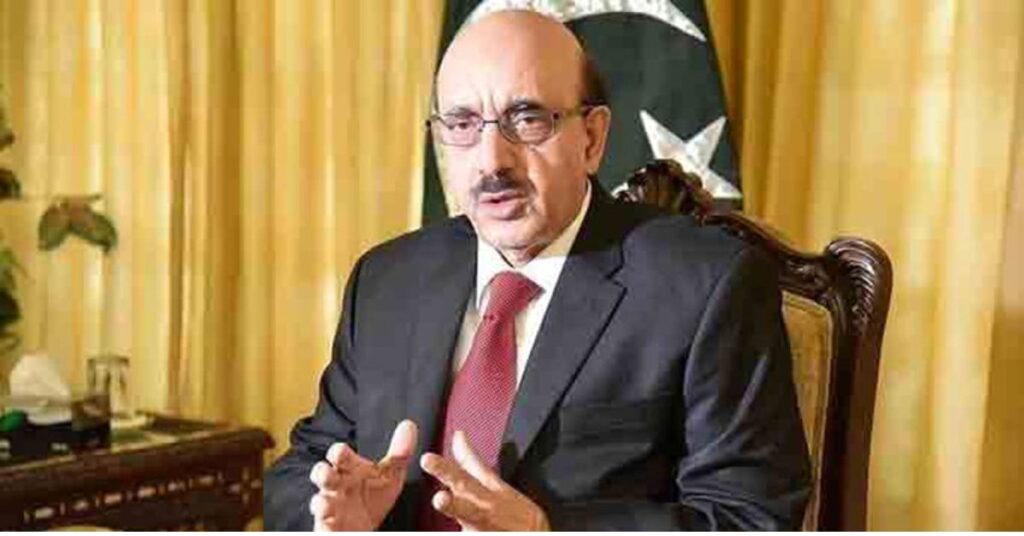
ISLAMABAD (Kashmir English): Ambassador Masood Khan, former President of Azad Jammu and Kashmir and former Ambassador of Pakistan to the United States, China, and the United Nations, has stated that India’s recent trade agreement with the United States reflects strategic compulsion rather than strategic choice.
He asserted that Prime Minister Narendra Modi had little room for maneuvering following India’s diplomatic and strategic setbacks after the May 2025 India-Pakistan conflict.
Ambassador Khan observed that the agreement emerged after India found itself increasingly isolated in the aftermath of the conflict, with bilateral tensions and international scrutiny narrowing New Delhi’s diplomatic space.
He noted that both India and Pakistan had reached a strategic stalemate, while President Donald Trump openly criticized India and its leadership, placing additional pressure on Prime Minister Modi to repair strained ties with Washington.
He explained that India sought to diversify its external partnerships by improving trade relations with China, strengthening its engagement with Russia, and concluding a long-pending free trade agreement with the European Union.
However, he said, coercive diplomatic pressure from Washington accelerated the US–India trade arrangement, which he described as largely favourable to American economic interests.
Ambassador Khan pointed out that under the agreement, US tariffs on Indian goods and services have been reduced to 18 percent, while India has eliminated tariffs on American goods and services altogether, effectively opening its domestic market to US investors and entrepreneurs.
He added that India has also committed to investing approximately $500 billion in the United States across key sectors, including technology, agriculture, and energy, calling it a significant strategic and economic gain for Washington.
Highlighting the strategic implications of the deal, Ambassador Khan noted that India had crossed long-standing red lines, particularly in agriculture, where tariff protections had historically been regarded as politically and economically sensitive.
He said that the concessions would pose serious domestic challenges for Prime Minister Modi, especially in convincing India’s farming community that such measures would not undermine their livelihoods.
Ambassador Khan further observed that the agreement, coupled with India’s free trade arrangement with the European Union, could expose vulnerable sectors of the Indian economy to intense external competition.
He warned that these agreements might disproportionately affect marginalized and lower-income communities, while simultaneously facilitating an influx of luxury goods, advanced technologies, and industrial products from Western markets at highly competitive prices.
Commenting on the strategic dimension of the deal, Ambassador Khan stated that the United States had also secured commitments from India to gradually reduce its reliance on Russian oil and shift energy imports toward American and alternative suppliers.
He noted that India had previously continued substantial oil purchases from Russia despite public assurances to the contrary, and the new arrangement marks a significant recalibration of New Delhi’s foreign policy priorities.
Ambassador Khan said that India’s foreign policy narrative of “strategic autonomy” has increasingly come under scrutiny, with critics within India arguing that recent policy decisions have pushed the country toward what they describe as strategic uncertainty and economic vulnerability.
He added that India’s international image has also been affected by its aggressive posture during last year’s conflict with Pakistan, which exposed gaps between its projected military capabilities and operational realities.
While analyzing the broader regional impact, Ambassador Khan stressed that Pakistan must remain vigilant in the wake of renewed US–India engagement.
He noted that Pakistan had made notable diplomatic gains in Washington over the past year, strengthening its engagement with US policymakers and enhancing mutual confidence, particularly with President Trump and key decision-making circles.
He cautioned that India maintains significant influence within US political and policy institutions and may attempt to use its renewed strategic engagement with Washington to create diplomatic pressure on Pakistan.
Ambassador Khan emphasized that Islamabad should continue proactive diplomacy and economic reform to consolidate its strategic gains and maintain balanced relations with global powers.