
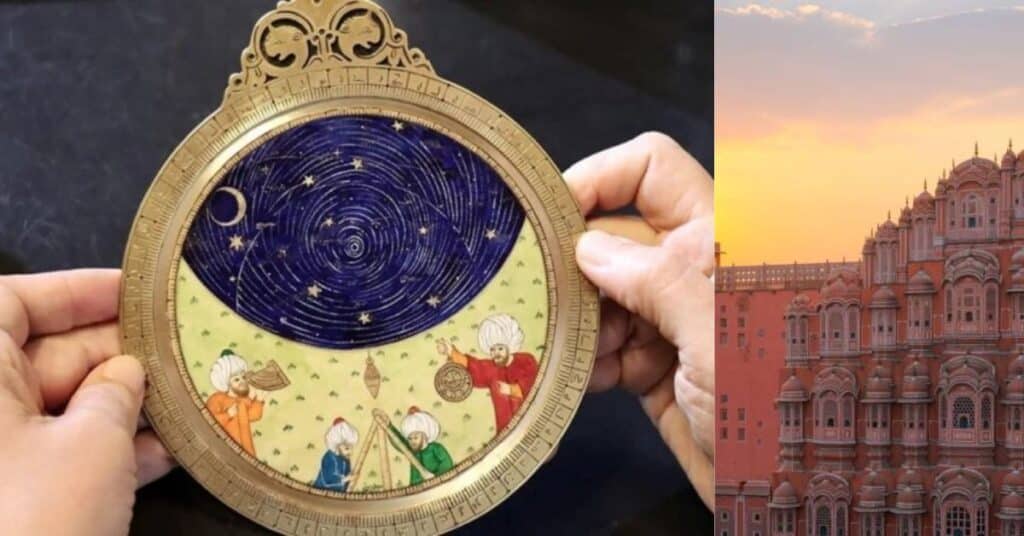
LONDON (Kashmir English): A rare 17th-century astronomical masterpiece from the royal collection of Jaipur in western India will be offered at an auction by Sotheby’s in London today (April 29).
The masterpiece is known to have formed part of the royal holdings of Sawai Man Singh II, the maharaja of Jaipur, and was inherited by his wife, Maharani Gayatri Devi—widely regarded as one of the most elegant women of her era—following his death.
It was later moved to a private collection during her lifetime.
Astrolabes, metallic disks made up of multiple interlocking layers, were historically used to tell the time, map the stars, determine the direction of Mecca and track the motion of the sky.
The instrument was originally conceived by ancient Greek astronomers around the 2nd century BCE which later extended to the Islamic world by the 8th century, where it was significantly refined.
In the centuries that followed, major centres of production emerged across regions, including Iraq, Iran, North Africa and al-Andalus in present-day Spain.
“They are essentially a two-dimensional projection of a three-dimensional universe. I compare them to modern-day smartphones because you can do so many things with them,” Dr. Federica Gigante of the Oxford Centre for History of Science, Medicine and Technology, told the BBC.
“You can calculate the time of sunset, sunrise, the height of a building, the depth of a well, distance and even use them to predict the future. Along with an almanac they were once used to cast horoscopes.”
It is believed that the instrument was crafted in the early 17th century in Lahore, in present-day Pakistan. Then a key production center within the Mughal Empire, by brothers Qa’im Muhammad and Muhammad Muqim stared production.
Commissioned by Mughal official Aqa Afzal, who served under emperors Jahangir and Shah Jahan, the piece reflects both scientific advancement and elite patronage in the imperial court.
“It weighs 8.2kg, measures nearly 30cm in diameter and stands about 46cm tall – almost four times the size of a typical astrolabe from 17th Century India,” said Benedict Carter, head of the Islamic and Indian Art department at Sotheby’s.
Weighing more than 8 kilograms and measuring nearly 30 centimeters across, the astrolabe stands out for its scale. It contains inscriptions of 94 cities with their geographic coordinates, along with numerous star pointers connected by intricate decorative patterns.
The astrolabe is not only big, beautiful and heavy, it is so incredibly accurate that it will give the exact degree of altitude [of a celestial body.
Auction estimates
Sotheby’s estimates the astrolabe will sell for between £1.5m and £2.5m. The item was exhibited in London from April 24.