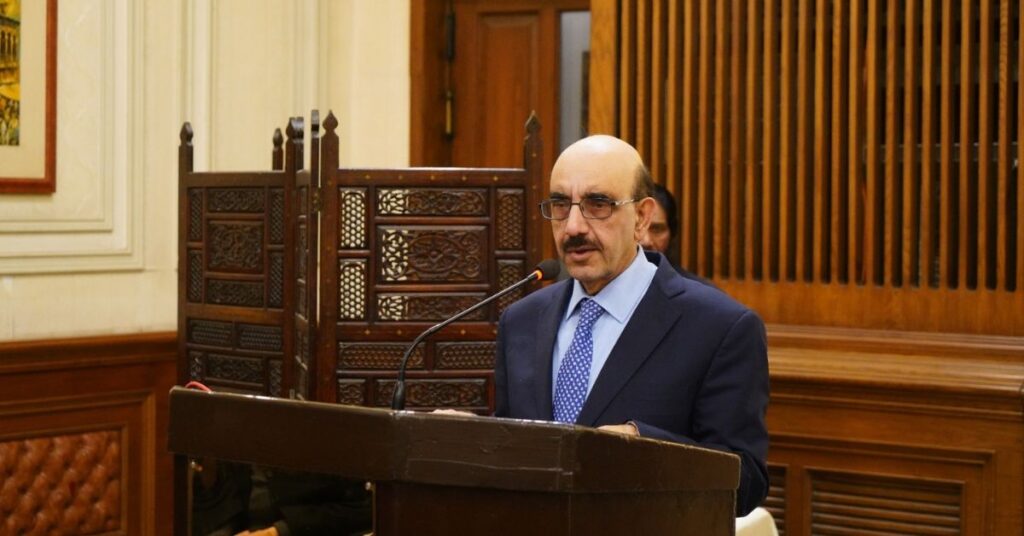
ISLAMABAD (Kashmir English): Former President of Azad Jammu and Kashmir and former Pakistan Ambassador to the United States and the United Nations, Masood Khan, has cautioned that the deepening crisis between the United States and Iran represents one of the most dangerous flashpoints in the Middle East.
He lamented that the crisis is marked by the near-total absence of diplomacy and warned of a growing risk of military escalation with grave consequences for regional and global security.
Speaking during a televised discussion on unfolding protests in Iran and the evolving US posture, Ambassador Khan said the situation is far more volatile than past episodes of unrest.
While protests are internal in nature, he warned that the external dimension is expanding rapidly, creating a “very scary” scenario for peace and stability.
He stressed that Pakistan, as Iran’s immediate neighbour with a shared border of nearly 900 kilometres, would be among the countries most directly affected by any escalation.
Ambassador Khan noted that President Donald Trump’s statements — indicating openness to talks while simultaneously threatening military action — have injected further uncertainty into an already fragile situation.
Iran unrest
He observed that what began as domestic unrest, largely driven by economic distress and the cumulative impact of long-standing sanctions, is increasingly being internationalised, raising the risk of external intervention.
Addressing the roots of the crisis, Ambassador Khan emphasized that Iran’s core challenge is economic rather than purely political. He said sanctions have inflicted sustained hardship on ordinary Iranians, fueling frustration and instability.
“While Iranian authorities claim to be managing the situation internally and restoring calm, these assertions are often contradicted by international reporting.”
At the same time, Khan noted that Tehran believes hostile external actors — particularly the United States and Israel — are exploiting the unrest to pursue long-standing objectives of regime change.
He warned that the strategic environment is deteriorating further due to the absence of credible mediators.
According to Ambassador Khan, traditional diplomatic frameworks have collapsed: the P5+1 process is defunct, the United States has withdrawn from earlier agreements, and Russia and China are no longer positioned to play a bridging role.
European states, he said, have instead moved toward tightening sanctions, further narrowing diplomatic space.
Instability in Iran could disrupt border trade
Highlighting regional repercussions, Ambassador Khan said instability in Iran could disrupt border trade, threaten energy supplies, and undermine security along Pakistan’s western frontier.
He cautioned that any conflict affecting the Strait of Hormuz would have immediate global economic consequences, driving up oil prices and disrupting supply chains.
He also underlined concerns that porous borders could be exploited by hostile intelligence agencies, aggravating security challenges for Pakistan.
Concluding his remarks, Ambassador Masood Khan said the situation remains fluid and unpredictable, with no clear solution in sight.
He urged the international community to activate whatever diplomatic channels remain to prevent a catastrophic conflict.