
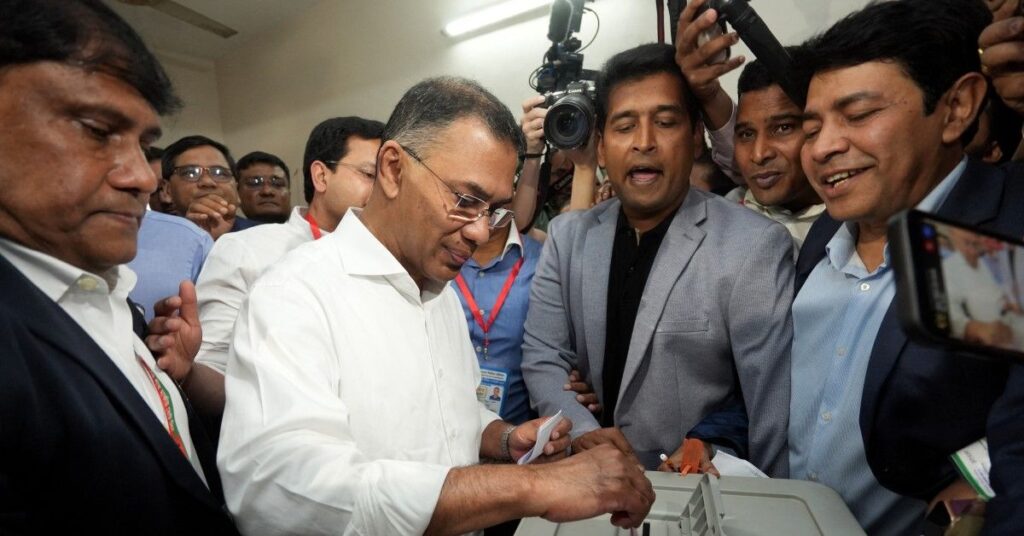
DHAKA (Kashmir English): The Bangladesh Nationalist Party (BNP) has won a historic parliamentary election, according to local media reports.
According to Ekattor TV, the BNP won 151 seats in the 300-member National Assembly in the Bangladesh elections 2026, enough to form a government.
Its rival, Jamaat-e-Islami, won 42 seats. The party’s leader, Shafiqur Rahman, had signaled his intention to concede defeat even before the BNP secured a simple majority.
Addressing a press conference in Dhaka at midnight on Thursday, Jamaat-e-Islami leader Shafiqur Rahman said that his party would not simply do politics of opposition for the sake of opposition. He said that the party would do positive politics.
The voter turnout in Bangladesh elections 2026 was higher than the 42 percent recorded in the 2024 elections. Local media reported that more than 60 percent of registered voters cast their ballots.
The elections are the first national elections since the successful 2024 Generation Z-led movement that ousted longtime Prime Minister Sheikh Hasina.
Analysts say a clear election result is crucial for stability in the country of 175 million, where deadly anti-Prime Minister Sheikh Hasina protests have disrupted daily life and major industries, especially the garment sector (the world’s second-largest exporter), for months.
These are the first national elections since recent youth-led movements around the world, with Nepal also due to vote next month.
According to Reuters, the elections are expected to bring political stability to the troubled South Asian country.
Counting began at 4:30 p.m., shortly after voting closed in most polling stations, according to Election Commission officials. Clear trends are expected to emerge by midnight, and final results are expected by Friday morning.
The elections were accompanied by a referendum on constitutional reforms, including the establishment of a neutral interim government during the election period, converting the parliament to a bicameral system, increasing women’s representation, strengthening the independence of the judiciary, and setting a two-term limit for the prime minister.
More than 2,000 candidates were on the ballot, a large number of whom were independents, while at least 50 parties participated, a national record. Voting in one constituency was postponed due to the death of a candidate.