SRINAGAR (Kashmir English): Tucked deep into the foothills of south Kashmir, in Indian illegally occupied Jammu and Kashmir, the twin villages of Cheki-Isherdas and Wantrag having Afghans as majority residents, sit along a narrow irrigation canal, surrounded by terraced fields, winter vegetable patches, and groves of walnut and apple trees.
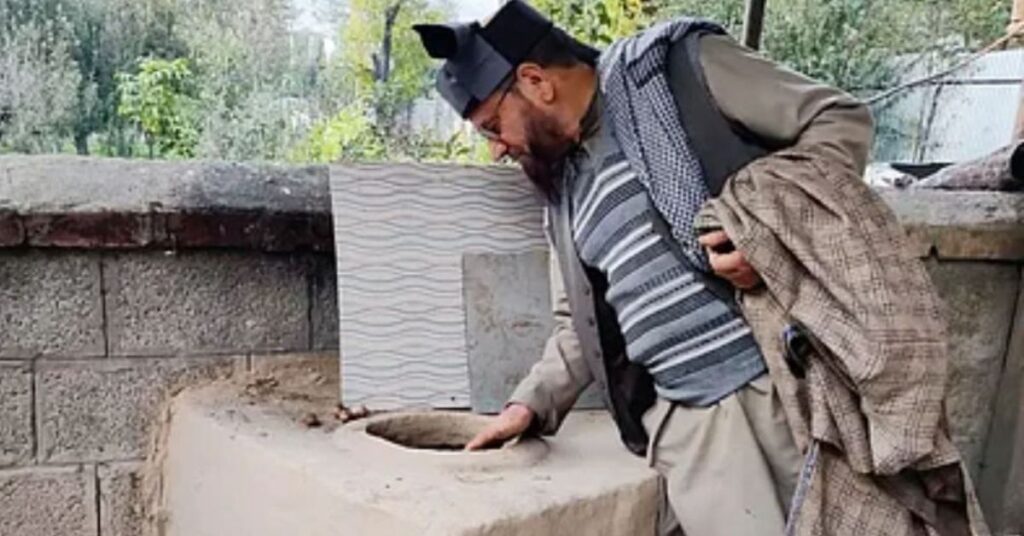
According to Kashmir Media Service, Bashir Ahmad Pakhtoon (70), a retired teacher and Pashto activist, wrapped in a traditional Pathani outfit with a woolen chadar over his shoulders, said: “Our village still carries a Pashtun imprint”.
Afghan-origin tribal culture
“Our language, food and customs distinguish us even today.” Home to nearly 600 Pashtun households, the villages form a rare enclave of Afghan-origin tribal culture in Islamabad district.
Pashtun settlements also exist in other parts of Kashmir, including Gutlibagh-Ganderbal, Srinagar, Baramulla, Kupwara and Pulwama. Wantrag, however, remains one of the few places where Pashto language and customs are still prominently visible.
The road to Wantrag climbs a hill about 15 kilometres from Islamabad town, cutting through apple orchards.
The village presents scenes uncommon in much of Kashmir – shop signboards in Pashto, the aroma of Kabuli Pulao, and men in Pashtoon dress and chadar working along canal banks.
For outsiders, communication can be difficult, as many residents primarily speak Pashto. Social affairs are governed by a traditional Jirga system, elders say.
“The community continues to follow the Jirga, a traditional council that resolves disputes and takes collective decisions based on consensus, guided by Pashtunwali, the Pashtun code of conduct,” said Basheer, a tribal elder who is also head of the local jirga.
The crime rate here is almost zero. Very few matters ever reach the courts. Children play cricket on narrow roads, while mud-and-wood houses line the slopes, giving the area the appearance of a Pashtun settlement rather than a typical Kashmiri village. The Pashtun presence in Wantrag dates back more than a century.
“During the rule of Maharaja Pratap Singh, this land was granted as a jagir to Isherdas, a Pashtun ruler who came from present-day Khyber-Pakhtunkhwa,” says Dost Muhammad Khan (80), a retired Tehsildar.
“My parents were brought here by Isherdas, and we settled permanently,” he added. “I was born and raised here. In those days, there were only a few Pashtun families.”
Over time, Pashtuns from Khyber-Pakhtunkhwa and Afghanistan joined the settlement. Farming particularly vegetables and walnuts became the main source of livelihood.
“Literacy levels were very low earlier,” Dost Muhammad said. “When I completed my graduation and later joined the revenue department, it encouraged others to educate their children. That change is now visible. Today, we have graduates and postgraduates,” Bashir said.
Dost Muhammad’s son, Ali Muhamad, recently retired as a higher secondary school principal. Despite social progress, residents say the community remains excluded from official protections. “We are described as Pathans, Pashtuns or sometimes even Paharis,” Bashir said.
“But when it comes to reservations in jobs and education, we are left out.” Reservation eligibility in Jammu and Kashmir has often been linked to the Pahari language, which many Pashtuns say excludes them.
“There is no constitutional basis for linguistic based reservation,” Bashir said. “We are a tribal community. That alone should make us eligible.” While many Pashtuns today speak Kashmiri and Pahari, Bashir insists Pashto ethnicity remains central to their identity.
Pashto once enjoyed official recognition in Kashmir. “When Radio Kashmir began broadcasting in 1948, Pashto news and cultural programmes continued until 1967,” Bashir said.
“No other regional language had that status at the time. That support has since disappeared.” Today, Pashto survives mainly as a spoken language, he said.
“There are no textbooks, no schools and no institutional backing.” In 1953, Pashtuns were granted Indian citizenship and recognised as a backward community.
A 1986 government survey later grouped them under the Gujjar community, but that classification was eventually withdrawn. “Today, we have no formal recognition,” Bashir said.
Cultural practices in Wantrag are gradually changing. “Earlier, the tribe strictly stuck to endogamic marriages” Bashir said. “In recent years, however, inter-community marriages have become more common.”
Traditional attire has also evolved. “The Pheran was once unfamiliar to us, but now many people wear it,” he says.
Still, elders are making efforts to preserve their heritage. A small Pashto booklet has been published for children, and families encourage tailors to continue stitching traditional Pathani clothing.
“We are deeply rooted in Kashmir,” Bashir said and added, “Preserving our language and culture is essential to knowing who we are”.