
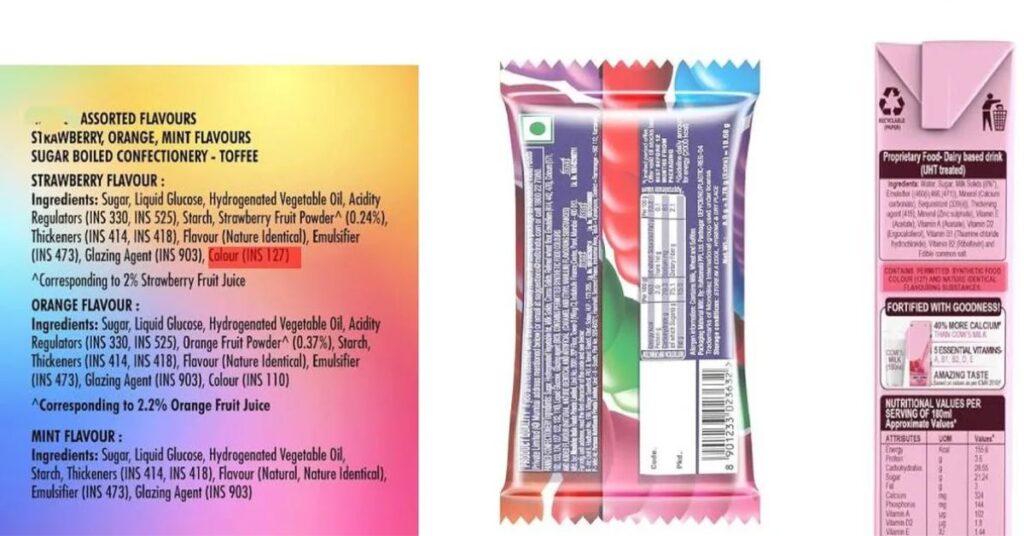
WASHINGTON (Kashmir English): The United States Food and Drug Administration (USFDA) has banned INS 127, a cancer-linked colour additive found in Indian strawberry milkshakes, candies, and chewing gum.
Whether it is a reputed brand or a newly launched one in the market, most brands are still using INS 127 called Red No. 3 or Erythrosine.
“FDA finds that FD&C Red No. 3 causes cancer in male rats by a mechanism specific to rats, involving hormones unique to them, and on this basis, we hereby revoke the listings granting on these uses of this color additive under section 721(b)(5)(B) of the FD&C Act, as explained below,” announced the FDA in the notice.
Under Indian law, Erythrosine, which is also known as FD&C Red No. 3, is recognized as a food color of a synthetic nature, as per the Food Safety and Standards (Food Products Standards and Food Additives), Regulations, 2011.
It is classified as INS-127, on the basis of the International Numbering System of Food Additives.
In India, the usage of INS 127 is permitted in the following products:
- Powdered soft drinks
- Concentrate mixes/fruit beverages
- Custard powder
- Jelly crystals
- Ice candies
- Thread sweets
- Candies
- Wafers
- Flavour emulsions
- Flavour pastes (for carbonated and non-carbonated water only)
- Chewing gum
- Bubble gum
Erythrosine imparts a bright red color to candies, baked goods, desserts, etc. It also visually appeals in the making of many products, like cakes, cookies, frostings, and frozen desserts.
However, its use has raised one or two health concerns because it is believed to possess carcinogenic properties. It was observed to induce cancerous growth in laboratory rats, raising some question about its safety in food products.
While in India Erythrosine is still permitted in foods, the regulatory environment has begun to change: the U.S. FDA recently announced a ban on food and ingested drugs containing Erythrosine, citing similar health concerns. Such a move may result in further alterations in other countries’ practices.
USFDA Action
U.S. regulators on Wednesday, 15 January, banned the dye called Red 3 from the nation’s food supply, almost 35 years after it was prohibited in cosmetics due to its potential cancer risk.
The FDA said, “We are withdrawing the certification of colour additive for use in food and ingested drugs because of the Delaney Clause of the FD&C Act.”
The Delaney Clause, added in 1960 as part of the Colour Additives Amendment to the FD&C Act, bars FDA approval of a food additive or colour additive that has been shown to induce cancer in humans or animals.
As noted by the FDA, “Data presented in a 2022 colour additive petition show that this ingredient causes cancer in male laboratory rats exposed to high levels of FD&C Red No. 3 through a hormonal mechanism specific to male rats.”
However, the agency pointed out that studies in other animals and humans did not show the same effect and there is no evidence suggesting that FD&C Red No. 3 causes cancer in humans.
The FDA underscored, “Color additives, including FD&C Red No. 3, must undergo premarket review and approval.
The law requires proof a color additive is safe for use in foods under its intended conditions of use before it can be added to foods.
When manufacturers want approval for a colour additive, they send in a petition with their data and information. The FDA takes a look at this data and considers the probable quantity consumed, intended use, manufacturing process, and the physical and chemical properties of the additive.
“If the data available demonstrates that the substance is safe under the proposed conditions of use, the agency issues a regulation authorising its use.”
However, “Where data show that a color additive proposed for use in foods, drugs, or cosmetics is found to induce cancer in man or animals by appropriate tests prescribed by the relevant section of the federal Food, Drug, and Cosmetic Act, the Delaney Clause instructs the FDA to find such uses unsafe,” the FDA explained.
As the labelling regulations are explained in greater detail by the FDA, “Certified colours must be declared in the statement of ingredients on food labels as ‘FD&C Red No. 3,’ or without the ‘FD&C’ prefix or the term ‘No.’ – for example, ‘FD&C Red 3’ or ‘Red 3.’”