
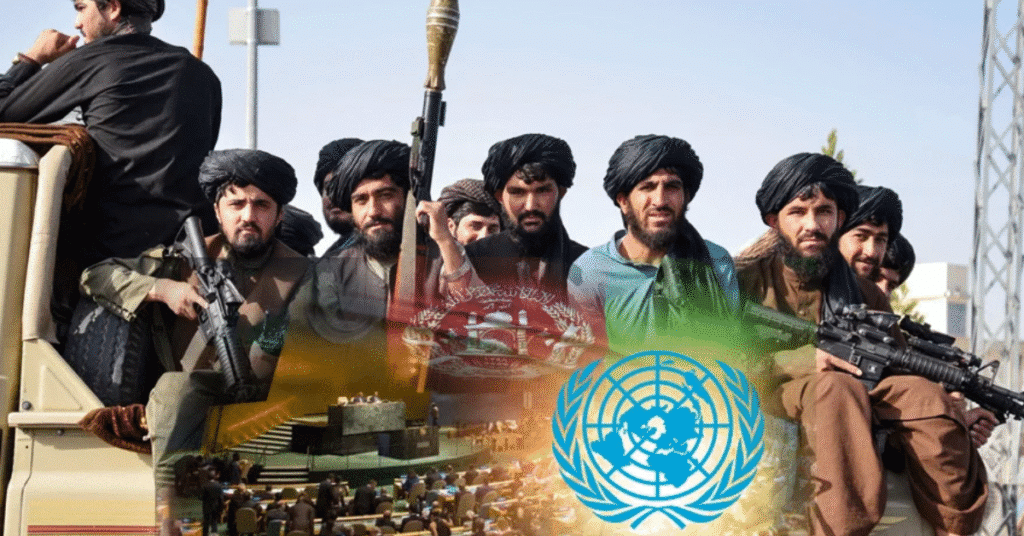
LONDON (Kashmir English): A new report to the United Nations Security Council has rejected the Taliban government’s claim that Afghan soil is not being used for cross-border terrorism.
The report calls this claim “unconvincing” and warns that neighboring countries are increasingly seeing Afghanistan as a source of regional instability.
The assessment comes in the sixteenth report of the Security Council’s Analytical Support and Sanctions Monitoring Team, which covers the overall security situation in Afghanistan four years after the Taliban returned to power in August 2021. The report says that the de facto authorities have consistently denied the presence or operations of terrorist groups in Afghanistan, but these claims cannot be considered credible.
The report recalls that the Taliban had assured under the 2020 Doha Agreement that Afghan soil would not be used against any other country. However, although the Taliban have cracked down on ISIS-K since taking power, their approach to other terrorist organizations has been different.
According to the United Nations, member states continue to receive reports that ISIS-K, Tehreek-e-Taliban Pakistan, Al-Qaeda, the Eastern Turkestan Islamic Movement or Turkestan Islamic Party, Jamaat Ansarullah, Ittehad-e-Mujahideen Pakistan, and other armed groups are present in Afghanistan. The report says that some of these groups have used Afghanistan to plan and prepare for external attacks, or are still using it.
According to the report, Al-Qaeda maintains close ties with the Taliban and has a presence in several Afghan provinces. Although its activities have been kept at a low level, the monitoring team says that it has an environment that allows it to train and reorganize. In contrast, ISIS-K is considered the Taliban’s main adversary, whose territorial hold has weakened, but its ability to attack remains.
The report identifies the Tehreek-e-Taliban Pakistan (TTP) as the biggest threat to regional stability. The group has strong support from some Taliban factions and operates from Afghan sanctuaries, the report said.
Taliban officials have denied responsibility for failing to contain the TTP, while there are varying levels of sympathy and commitment to the group within the Taliban.
The United Nations says the TTP has carried out several high-profile attacks in Pakistan from Afghan soil. The report said that TTP attacks in Pakistan have increased steadily in 2025, with some estimates suggesting that more than 600 attacks have taken place so far this year, including vehicle-borne improvised explosive devices and suicide bombers. It added that the majority of suicide bombers in Pakistan are Afghan nationals.
According to the report, Pakistan has long accused the Taliban of harboring about 6,000 TTP fighters, who are based in Khost, Kunar, Nangarhar, Paktika, and Paktia.
The report also said that TTP chief Noor Wali Mehsud lives in Kabul and, according to an unidentified member of the country, his family is paid 3 million Afghanis per month by the Taliban.
The report said that the presence of the TTP has affected relations between Pakistan and Afghanistan, and there have been cross-border clashes and disruption of trade.
The closure of border crossings with Pakistan is causing a loss of about $1 million to the Afghan economy every day. The report also said that the TTP has expanded the scope of its operations and has also started targeting businesses owned by the army.
On the other hand, the report also mentions some progress made by Pakistan in counter-terrorism, including the arrest of ISIS Khorasan spokesperson Sultan Aziz Azam on May 16, 2025.
According to the report, the overall capabilities of ISIS Khorasan have been weakened as a result of the operations of the Taliban and Pakistan. Regarding Al-Qaeda, the report states that in March 2025, Osama Mahmood was officially appointed as the emir of Al-Qaeda in the Indian Subcontinent.