
SRINAGAR (Kashmir English): As International Women’s Day is being observed worldwide today, the miseries and agonies of Kashmiri women continue unabated at the hands of Indian troops and police personnel in Indian illegally occupied Jammu and Kashmir.
A report published by Kashmir Media Service on the occasion of International Women’s Day said that the miseries and victimization of Kashmiri women at the hands of Indian forces—including the army, Border Security Force, Central Reserve Police Force, Special Operations Group, police and other agencies—continue unabated in occupied Jammu and Kashmir.
In 1947, during the Jammu massacres, mass rapes were perpetrated by Dogra troops alongside Hindu fanatics in a brutal campaign against the territory’s Muslim population. Thousands of Muslim women were abducted, raped and subjected to unimaginable horrors, particularly in Jammu, Rajouri, Poonch and Kathua.
These atrocities were not random acts of violence but a systematic attempt at ethnic cleansing, actively facilitated by the forces of the Dogra State under Maharaja Hari Singh.
Since the 1988 popular uprising, scholars and human rights organisations have consistently documented the use of rape as a weapon of war by Indian state forces, including the Indian Army, Central Reserve Police Force (CRPF) and Border Security Force (BSF).
The deliberate and targeted nature of these crimes underscores the continuing pattern of oppression in IIOJK, where sexual violence remains a tool of subjugation and terror against the local population.
After 1989, Indian forces selectively raped, tortured and killed Kashmiri Muslims and burnt their homes and business centers. Indian forces have committed rape as a form of retaliation against civilians who were demanding the right to self-determination under UN supervision.
According to a 1993 Human Rights Watch (HRW) report, Indian forces used rape as a method of retaliation against Kashmiri civilians. Most rape cases, according to the report, occurred during cordon-and-search operations.
In October 1992, representatives from the Asia Watch group and Physicians for Human Rights (PHR) traveled to Kashmir to document rape and other human rights abuses and violations of the laws of war by Indian forces. Later they released a book titled “Rape in Kashmir” on May 9, 1993.
Indian state terrorism in occupied Kashmir
The report revealed that since January 1989, Indian state terrorism has rendered 22,991 women widowed, while 11,275 women were molested by Indian forces’ personnel.
The report also reveals the devastating impact of Indian state terrorism on women in IIOJK. Since January 2001, at least 690 women have been martyred by Indian forces’ personnel.
The report further pointed out that the majority of Kashmiris suffering from multiple psychological problems are women.
The report cited some of the most heinous crimes committed against Kashmiri women, including the mass rape in Kunan-Poshpora, the rape and murder of Aasiya Jan and her sister-in-law Neelofar Jan in Shopian, and the rape and murder of 8-year-old Aasifa Bano in Kathua, each exposing the culture of impunity granted to the Indian forces establishment in the territory.
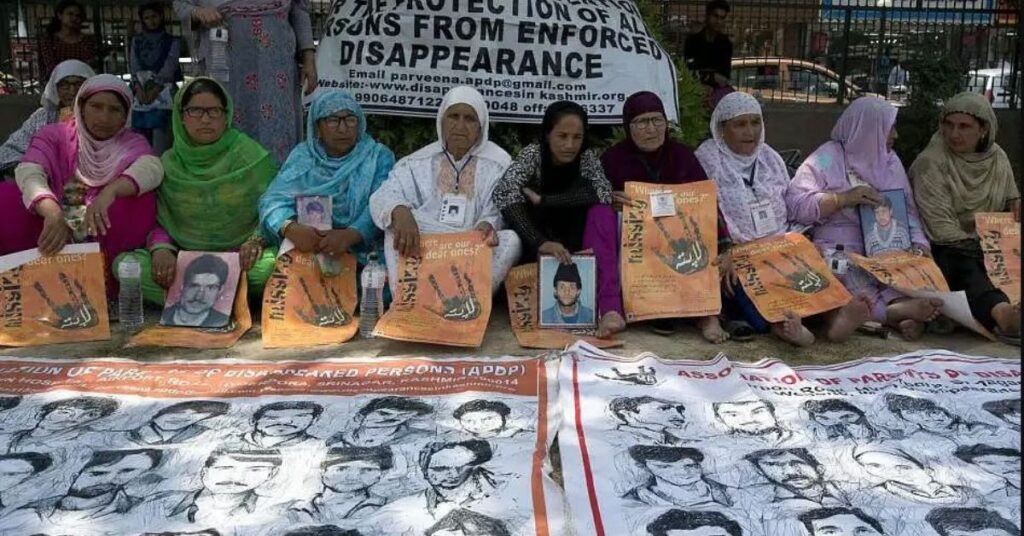
The report said that thousands of women lost their sons, husbands, fathers and brothers in the occupied territory who were subjected to custodial disappearances by Indian troops. According to the Association of Parents of Disappeared Persons, 8,000 Kashmiris went missing in custody during the past 38 years, inflicting pain and agony on the womenfolk of the occupied territory.
The report said that over three dozen Kashmiri women—including Hurriyat leaders Aasiya Andrabi, Fehmeeda Sofi and Naheeda Nasreen—languish in Indian and IIOJK jails, facing political persecution for championing Kashmiris’ right to self-determination. They are being politically victimized only because they represent the aspirations of the people of Jammu and Kashmir and their demand for the right to self-determination, it added.
The report highlighted the widespread use of pellet guns by Indian troops, leaving thousands of schoolchildren injured and blinding over 100, including 19-month-old Hiba Jan and 2-year-old Nusrat Jan.
From Azad Jammu and Kashmir, around 400 women who married Kashmiri youth are facing injustice as the Indian government is neither granting them citizenship rights nor travel documents to return to AJK. Their children are also denied admission to government schools.
The report said Kashmiri women continue to face immense political and social pressure, citing the case of Rafiqa Begum, wife of illegally detained Hurriyat leader Ayaz Akbar, who died of cancer in 2021 while her husband remained imprisoned in Tihar Jail.
International Women’s Day is celebrated every year on March 8 since 1910. In 1975, the United Nations designated it as a day to celebrate women’s achievements and advocate gender equality.